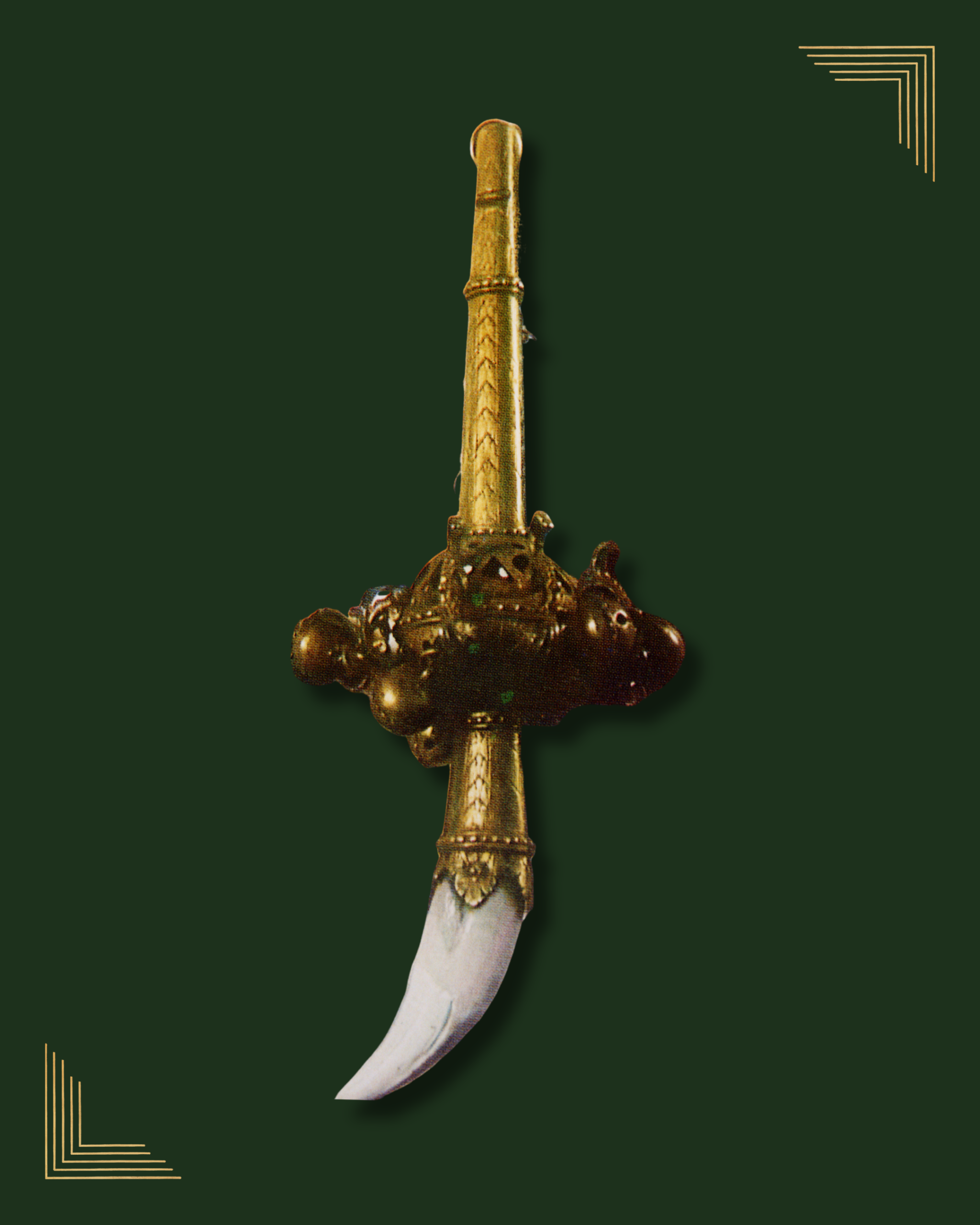
In this 17th century example, we can see a decorative gold rattle with a whistle at one end, an ornate bulbous section decorated with bells and set at the other end of the rattle is a teething ‘gem’ – documented as a bear’s tooth.
This rattle is very similar in form to a 16th century silver example depicted in two family portraits of the Thynne children, attributed to the painter Hans Eworth. In the first portrait we have 6 month old Francis Thynne 1564 (Fig 147) and then his 20 month old sister painted in 1572 (Fig 148) – these are the children of Sir John Thynne the builder of Longleat House in Wiltshire, England.
This style of rattle – known as ‘whistle and bells’ – appears in many children’s portraits dating from the 16th century onwards, and the ‘gem’ – set at the end of rattles are often mistaken as stems of coral. Coral has been associated with children as a protective amulet since ancient times and its inclusion in rattles was to aid with teething itself but also to protect against the ‘evils of teething’. As the cutting of the first tooth was a perilous time in a young child’s life – often resulting in death.
Certainly after the 17th century the majority of rattles did include a coral ‘teether’ set into such rattles – and coral rattles were particularly fashionable from the 17th century – but other suitable teething materials were also used.
In the paintings of the Thynne children (Fig 147 & Fig 148) – as in this example – it is obvious that the ‘gem’ set at the end of the rattle is white in colour and not pale pink or red, as would be expected if the material was coral. It is also curved and pointed in shape – which again highlights an alternative material, as the coral used in teething sticks and ‘coral and bells rattles’, would have been mounted in its natural ‘stem’, branch-shape or wavy forms.
Further investigation into the ‘amuletic’ history of rattles yields many examples with ‘pointed gems’ documented as being animal teeth, and explains that it was common practice (throughout Europe) to set such materials, as well as coral, at the end of children’s rattles.
The inclusion of wolf, bear and other animal teeth at the ends of baby rattles were intended as protective amulets. In fact teeth, in general, were thought to absorb or counteract the perceived dangers associated with infancy, particularly during the teething period.
For example, the attachment of a wolf’s tooth to children’s clothing or the infant’s body had been regarded throughout history as a method for the prevention of fear and toothache.
Similarly, stag’s teeth were commonly worn by children to relieve the pain of teething. Further associations link wolf’s teeth with symbols of virility and so, for children, they may have been intended as fertility amulets.
It is documented that in a number of Central European tribes, the teeth of various carnivores, mostly dog, wolf, bear and boar, were worn as protective amulets, mainly by female adults and children, whereas beaver-tooth amulets were more specific to all children.
In English folklore, to aid a child cutting its first teeth, a small bag containing either human teeth (often the teeth of the child’s mothers) or animal teeth, were hung round the infant’s neck as a protective amulet. This was a remedy so strong in English society that it even continued into the 20th century when calf’s teeth were still known to have been sold for this purpose in the London street markets of 1905.
Similarly, a European superstition to last until the second half of 19th century details how human teeth were tied to a ‘teething doll’, which was supposed to take on the pain of teething for the child. In the same way, the addition of teeth in rattles provided a teething aid, protective amulet and talismanic device to safeguard the teething process – whether it be the cutting of the first tooth as a pain reliever, or even to absorb the pain of the teething child.
So the inclusion of the bear’s tooth in this gold example and the animal’s tooth within the Thynne children’s rattle (Fig 147 & Fig 148) therefore served a dual function – as a practical teething aid and as a talismanic device intended to safeguard the child.
References:
This object is referenced here as part of a broader visual and textual study of children’s jewellery in historical art.
Fig 152: 17th Century
Gold ‘Whistle And Bells’ Teething Rattle Set With A Bear’s Tooth Amulet
– a 17th century long gold decorative rattle, featuring a whistle at one end, an ornate bulbous section decorated with bells and set at the other end with a bear’s tooth amulet for teething.
Bayerisches Nationalmuseum, Munich
Published in:
McAleer: Children’s Jewellery In Europe: Traditions And Contemporaneity: PhD Diss Royal College of Art, 2003: pp303-305 fig 152
Liselotte; Lenz: Amulett Magie Talisman: 1977 / 1999: p173 fig 248