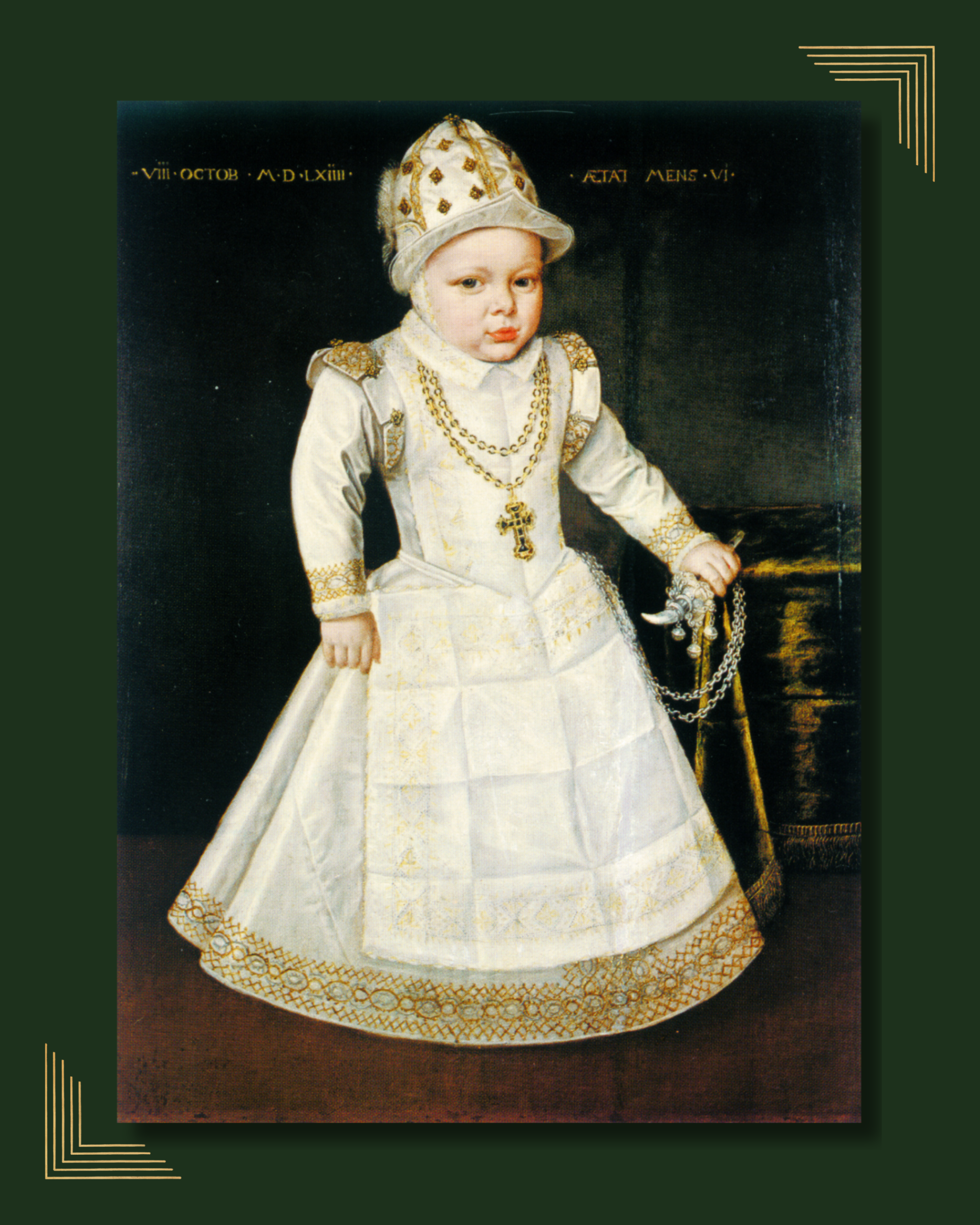
In the following portrait attributed to Hans Eworth, painted in 1564, the 6 month old Francis Thynne, 5th son of Sir John Thynne the builder of Longleat House in Wiltshire, England, is depicted holding the stem of a typical decorative rattle worn by 16th century children.
This consists of a long shaft, finishing at one end in a whistle and at the other end, in a mounted or set teething ‘gem’. Along the length of the shaft there is a more ‘bulbous’ section surrounded with bells and the rattle is attached to the child by means of a silver chain pinned to his waist.
The portrait of Francis Thynne also shows him wearing jewelled aglets on his cap and pinning the slashes of his sleeves at the shoulder, as well as a heavy gold neck chain in a double loop that supports a jewelled gold cross – the chain, cross and aglets being similar to fashionable adult jewellery items for this period.
This image is paralleled by an identical portrait of Francis’ younger sister – Fig 148 – again attributed to the artist Hans Eworth some 8 years later in 1572, which details the young girl at the age of twenty months. Like Francis, his sister is similarly adorned in a heavy gold chain looped twice around the neck supporting a jewelled pendant cross and jewelled aglets pinning the slashes of her sleeves at the shoulder.
Francis’ sister is also holding a silver rattle, attached to her waist by a silver chain – and it is clear that it’s the same one as in Francis’ portrait. In this painting (Fig 148) the rattle’s construction is clearly visible, being painted in greater detail – highlighting that its ‘bulbous’ section is decorated with spiral wirework along with three hanging bells and a mounted pointed gem.
The striking similarity of the children’s jewellery in these two portraits implies that the necklace, pendant and rattle adorning Francis in 1564, must be the same as that worn by his sister in 1572 (Fig 148). This suggests that such pieces were family heirlooms being passed to younger siblings as the necessity arose.
Francis, at the time of his sister’s portrait, would have been 8 years of age, and therefore would not require a rattle. Rattles were intended for babies and young infants to amuse them, help them teethe and guard them against the various ‘evils of teething’ and other infantile illnesses. Often referred to as ‘whistles and bells’ – the sound of the whistle and the bells were not only meant to entertain, but were literally thought to ‘scare away’ evils with their noise.
Older children, therefore having survived the ‘perils of infancy’, were perhaps thought to have ‘outgrown’ their rattles and not be in need of such amulets. For a child to discard their rattle could suggest that no individual sense of attachment or sentiment surrounded such an artefact – to the child themselves. Perhaps such items of childhood were considered ‘childish’ – or perhaps the older child knew he was expected to pass the rattle to younger siblings.
Another possibility, views both paintings as status symbols to indicate the family’s continuing wealth and position in society at the time. Although we know rattles were used by infants in everyday life (to entertain them, protect them and for teething), perhaps the adults who bought the actual pieces intended the more ‘precious’ and expensive varieties to be used specifically in portraits as a statement of their affluence.
This could be equally true of the portrayal of the gold chain and jewelled pendant cross in both portraits. As the long chain is wrapped twice around the necks of the children – this could suggest that the chain and pendant was an adult piece given to them to wear for the portrait – and shortened to fit them.
Long chains and crosses were similarly worn by adults at the time – as were jewelled aglets that pinned clothing. So for the Thynne’s – the inclusion of such pieces highlighted the wealth and status, not only of the children, but also of the family itself.
Cross pendants were used in portraits to convey faith, piety and devotion. They were also a powerful protective amulet for children – hence to be protected by God himself. The Thynne’s gold cross is set with dark gems – possibly diamonds (which were often portrayed as dark in colour in paintings from this time) – and is likely to be a further nod to the family’s wealth.
These portraits show us that such expensive items – the rattle and the gold chain with the jewelled cross – were not only kept as important family heirlooms, but were worn in portraits to convey wealth and status – whilst indicating that the children were ‘fashionably’ dressed.
In many children’s portraits featuring ‘whistle and bells’ rattles – the ‘gem’ – set at the end of rattles are often mistaken as stems of coral, incorporating all the amuletic properties associated with coral teething sticks. Coral has been associated with children as a protective amulet since ancient times and its inclusion in rattles was to aid with teething itself but also to protect against the ‘evils of teething’. As the cutting of the first tooth was a perilous time in a young child’s life – often resulting in death.
Certainly after the 17th century the majority of rattles did include a coral ‘teether’ set into such rattles – but other suitable teething materials were also used.
In the paintings of the Thynne children, it is obvious that the ‘gem’ set in their silver rattle is white in colour and not pale pink or red, as would be expected if the material was coral. It is also curved and pointed in shape – which again highlights an alternative material, as the coral used in teething sticks and ‘coral and bells rattles’, would have been mounted in its natural ‘stem’, branch-shape or wavy forms.
Further investigation into the ‘amuletic’ history of rattles yields other examples with ‘pointed gems’ documented as being animal teeth, and explains that it was common practice (throughout Europe) to set such materials, as well as coral, at the end of children’s rattles.
In a 17th century example – Fig 152 – we can see a gold rattle, very similar in form to that in the portraits of Francis Thynne and his sister. This rattle (Fig 152) is documented to have a bear’s tooth set at one end of its decorative shaft, along with the usual whistle, decorative bulbous section and bells.
The inclusion of wolf, bear and other animal teeth at the ends of babies rattles was intended as a protective amulet. Teeth, in general, were thought to absorb or counteract the perceived dangers associated with infancy, particularly during the teething period. For example, teeth from wolves, bears and stags were believed to prevent fear, relieve teething pain and guard against illness, while also carrying associations with strength and vitality. And across Europe, and in English folklore, both animal and human teeth were worn or carried by infants to protect against the dangers of early childhood.
The inclusion of an animal’s tooth within the Thynne children’s rattle therefore served a dual function – as a practical teething aid and as a talismanic device intended to safeguard the child. The fact that this rattle has been ‘passed down’ from Francis to his sister also highlights its importance as an heirloom and as a practical object used in the early lives of children. Whilst at the same time, its incorporation within both portraits of Francis and his sister (Fig 148) highlights that the children were also fashionably – hence reaffirming the Thynne family’s status in society.
References:
This object is referenced here as part of a broader visual and textual study of children’s jewellery in historical art.
Fig 147: 1564
Portrait of ‘Francis Thynne, Fifth Son of Sir John Thynne’ – depicting the 6 month old son of Sir John Thynne (builder of Longleat House) holding a silver whistle and bells rattle with animal tooth teether hung on a silver chain around his waist; jewelled aglets adorn his cap and sleeves; and a gold chain with a gold jewelled cross is looped twice around his neck.
Attributed to Hans Eworth, Netherlandish
Longleat House, England
Published in:
McAleer: Children’s Jewellery In Europe: Traditions And Contemporaneity: PhD Diss Royal College of Art, 2003: pp298-305 figs 147, 148 & 152
Buck: Clothes and the Child: A Handbook of Children’s Dress in England 1500-1900: 1996: p62 fig 35