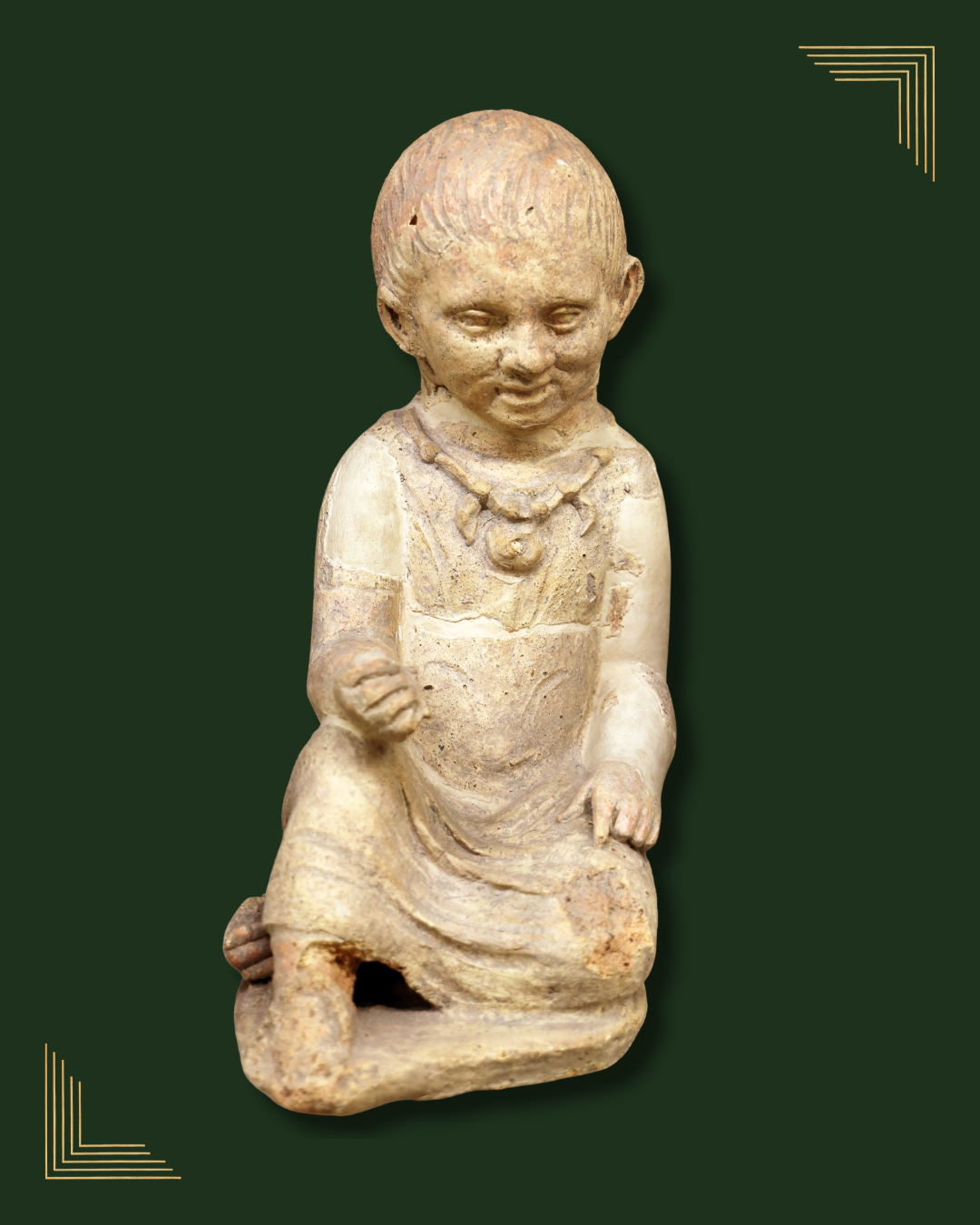
Although there are examples of Etruscan jewellery which illustrate that small jewellery types may be ‘attributed’ to children, the most conclusive piece of evidence to substantiate that children ‘wore’ jewellery in Etruscan times is the 2nd century BC stone statue of a young infant wearing a necklace.1Cristofani; Martelli: L’ Oro degli Etruschi: 1983: p24 Statues, in general, are not common examples of archaeological evidence from the Etruscan World and the representation of a child (especially one adorned with jewellery) is extremely unusual, if not exceedingly rare. The necklace itself, appears to be constructed from crude beads strung together on a length of string, with three pendants suspended at the front.2Ibid Two of the pendants are similar in form, possibly made from shells or animal teeth, and hang on either side of a large middle pendant, which is described as a bulla.3Ibid
The bulla is a well documented, ‘lens-shaped’, hollow container, which was worn originally by the Etruscans as a typical amuletic pendant.4Phillips: Jewelry: From Antiquity to the Present: 1996: p25
Higgins: Jewellery from Classical Lands: 1965 / 1976: p27
Higgins: Greek and Roman Jewellery (Second Edition): 1961 / 1980: p141 Its popularity dates back to the 5th century BC when it appears to have been initially worn as an ornament by both sexes and all ages, later aspiring to ‘amuletic’ status with the purpose of holding perfume or a charm.5Ibid
Ward-Perkins; Claridge: Pompeii AD79: 1976: fig 48
Newman: An Illustrated Dictionary of Jewellery: 1987: p51
Budge: Amulets and Superstitions: 1930 / 1978: p14-15 The bulla was such an integral part of Ancient life, that the Romans later adopted the form after they defeated the Etruscans in the 3rd century BC.6Phillips: Jewelry: From Antiquity to the Present: 1996: p25
Although not restricted to children during Etruscan times, the bulla’s role during the Roman era became more child-specific.7Ibid
Ward-Perkins; Claridge: Pompeii AD79: 1976: fig 48 The bulla, at a later date, had great importance in the lives of young Roman male citizens, who wore this particular pendant type, from infancy, as a symbol of free birth, as well as an amulet to ward off evil.8Ward-Perkins; Claridge: Pompeii AD79: 1976: fig 48
Knuf; Knuf: Amulette und Talismane: Symbole des magischen Alltags: 1984: p49
Murdoch: Treasures and Trinkets: Jewellery in London from Pre-Roman Times to the 1930’s: 1991: p28 Once a boy reached maturity and adopted adult fashions (i.e. the ‘toga virilis’) the bulla was ceremoniously dismissed.9Ward-Perkins; Claridge: Pompeii AD79: 1976: fig 48 Bullae were also worn by girls until they were married.10Higgins: Greek and Roman Jewellery (Second Edition): 1961 / 1980: p141
Knuf; Knuf: Amulette und Talismane: Symbole des magischen Alltags: 1984: p49
The bulla was also worn by generals at triumphs and by domestic animals. The amuletic role of the bulla further progressed in the Roman culture to include the sons of freedmen whereby gold bullae were reserved for the noble and leather bullae were worn by freedmen’s children.11Higgins: Greek and Roman Jewellery (Second Edition): 1961 / 1980: p141
Ward-Perkins; Claridge: Pompeii AD79: 1976: fig 48
The Romans are known to have referred to the amulet as the ‘Etruscan Aurum’ or the Etruscan gold ornament ‘par excellence’, and it was one of the few jewellery types which remained, stylistically, virtually unchanged throughout the Etruscan, Hellenistic and Roman periods.12Higgins: Jewellery from Classical Lands: 1965 / 1976: p27
Higgins: Greek and Roman Jewellery (Second Edition): 1961 / 1980: ppp141,150, 173-175
References:
Fig 32: 2nd Century BC
Stone Statue of a Young Infant wearing a beaded necklace with three pendants
Vulci, Italy
Museo di Villa Giulia, Rome
Statue available via:
National Etruscan Museum Of Villa Giulia, Rome
Wikimedia Commons:
Selected literature:
McAleer: Children’s Jewellery In Europe: Traditions And Contemporaneity: PhD Diss Royal College of Art, 2003: pp118-119 fig 32
Cristofani; Martelli: L’ Oro degli Etruschi: 1983: p24 fig XXI
Footnotes:
- 1Cristofani; Martelli: L’ Oro degli Etruschi: 1983: p24 ↩︎
- 2Ibid ↩︎
- 3Ibid ↩︎
- 4Phillips: Jewelry: From Antiquity to the Present: 1996: p25
Higgins: Jewellery from Classical Lands: 1965 / 1976: p27
Higgins: Greek and Roman Jewellery (Second Edition): 1961 / 1980: p141 ↩︎ - 5Ibid
Ward-Perkins; Claridge: Pompeii AD79: 1976: fig 48
Newman: An Illustrated Dictionary of Jewellery: 1987: p51
Budge: Amulets and Superstitions: 1930 / 1978: p14-15 ↩︎ - 6Phillips: Jewelry: From Antiquity to the Present: 1996: p25 ↩︎
- 7Ibid
Ward-Perkins; Claridge: Pompeii AD79: 1976: fig 48 ↩︎ - 8Ward-Perkins; Claridge: Pompeii AD79: 1976: fig 48
Knuf; Knuf: Amulette und Talismane: Symbole des magischen Alltags: 1984: p49
Murdoch: Treasures and Trinkets: Jewellery in London from Pre-Roman Times to the 1930’s: 1991: p28 ↩︎ - 9Ward-Perkins; Claridge: Pompeii AD79: 1976: fig 48 ↩︎
- 10Higgins: Greek and Roman Jewellery (Second Edition): 1961 / 1980: p141
Knuf; Knuf: Amulette und Talismane: Symbole des magischen Alltags: 1984: p49
The bulla was also worn by generals at triumphs and by domestic animals. ↩︎ - 11Higgins: Greek and Roman Jewellery (Second Edition): 1961 / 1980: p141
Ward-Perkins; Claridge: Pompeii AD79: 1976: fig 48 ↩︎ - 12Higgins: Jewellery from Classical Lands: 1965 / 1976: p27
Higgins: Greek and Roman Jewellery (Second Edition): 1961 / 1980: ppp141,150, 173-175 ↩︎