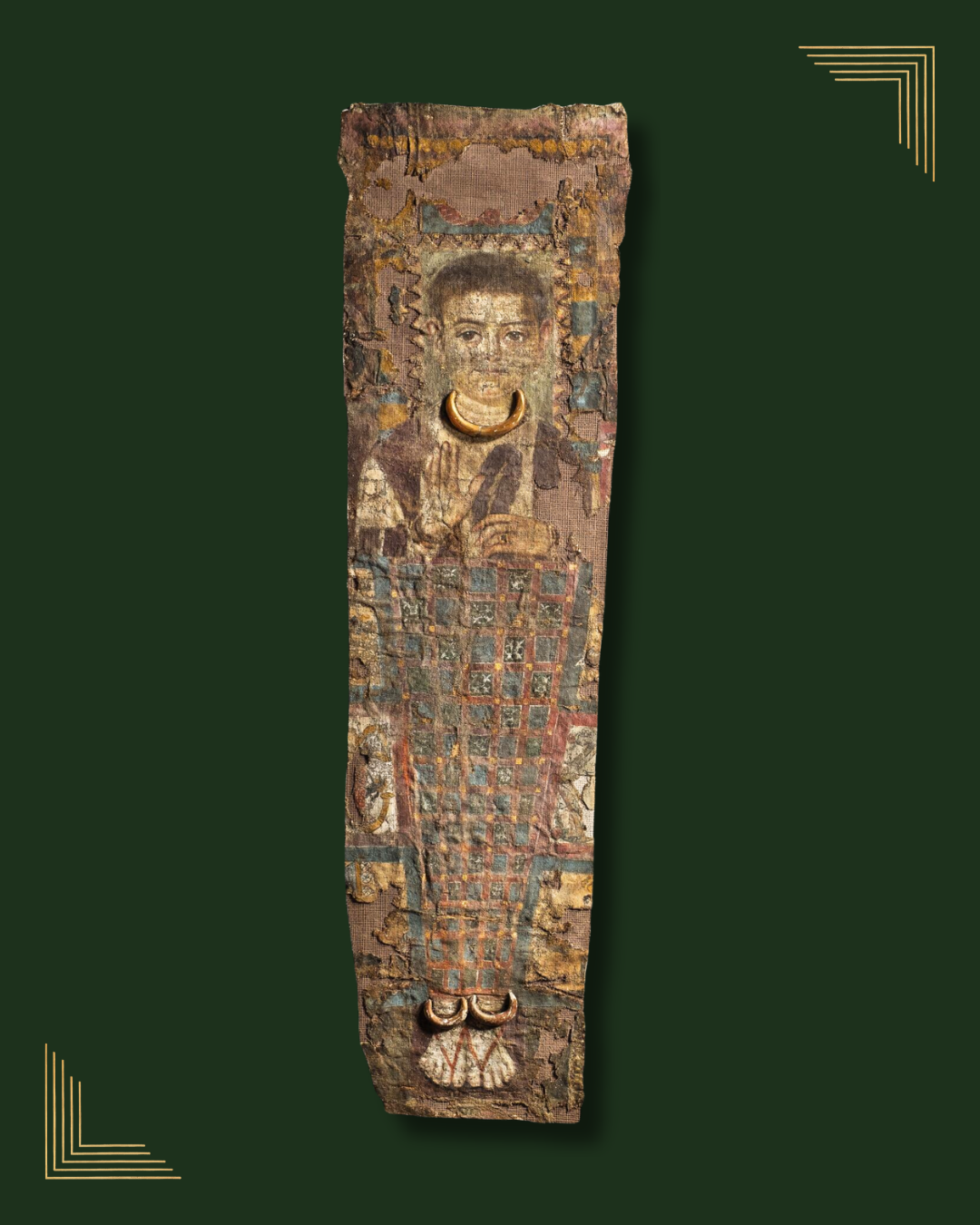
Here we have a rare Fayum Mummy Portrait detailing the full-length painted linen shroud of a young female identified as a baby girl in which the jewellery has been added in gilded plaster.
The Fayum Portraits – a collection of ‘funerary paintings’ found in the Fayum region in Egypt dating to the 1st – 3rd centuries AD – are considered unique due to the cross-fertilisation of cultures that they depict. They represent the area’s wealthy inhabitants who had been mummified along with their own personal painted portrait. The paintings are considered Romano-Egyptian showing typical Roman styles in terms of their hairstyles, clothing and jewellery – but are equally attributed to Egyptian funerary practices, as well as Greek and Roman painting styles. The portrait’s purpose was to preserve the deceased’s ‘likeness’ for the afterlife by allowing the spirit to recognise and return to itself each night – thereby granting immortality.
We’re told that it’s unusual to find a full length Fayum Portrait like this, especially one of a child – as most of the paintings consist of just the head and shoulders – and that this painting is even more unusual because the girl is depicted raising her right hand.
She wears a Roman-style white tunic with two broad maroon-purple ‘clavi’ (vertical stripes) and two bands of similarly coloured stripes decorate the ends of the sleeves. Her hair is cut short and worn close to her head – signalling she is a girl. In her left hand, she holds a floral garland – the same colour as the decoration of her tunic – and as mentioned, her right hand is raised, with her palm facing outwards.
Below her head and shoulders, she can be seen wearing an ‘apron’ featuring a dark red-brown and gold grid – or net – filled with blue squares in an alternating ‘rosette’ pattern. This is said to imitate depictions of shrouded gods like Osiris and painted around her are other Pharaonic funerary scenes
Although this full-length painting is noted to be unusual, the child is likened in style and composition to other female examples in which two women can also be seen raising their right hands with palms facing outwards. However the adult portraits differ because the two women carry an ‘Ankh Cross’ in the left hand, whereas this baby girl holds a garland of flowers.
It’s thought that the raising of the right hand could symbolise being raised in blessing or prayer…or it was a symbol to ward off evil – literally intended like a ‘stop, don’t come any closer’ sign to physically defend the body. The Ankh was an Egyptian symbol of ‘power to breathe life into things’ – something the women would need to bring themselves back to life in the afterlife. What’s interesting is that this hand gesture and cross, later become part of ‘icon’ paintings – but in reverse.
So why doesn’t the child also hold an Ankh Cross – yes she raises her right hand but in her left hand she holds a garland of flowers. Flowers were symbolic of rebirth, since flowers die and come back to life each year. The ‘bound garland’ was often found in Romano-Egyptian contexts, where fresh flowers were threaded into wreaths, collars and garlands to be worn on the body or held in the hands of the deceased during burial. These were objects that were intentionally made and served as ritual objects, specifically chosen by the deceased’s family for their journey into the afterlife. In a funerary context, the garland symbolised rebirth, resurrection and happiness in the afterlife – so in a way it has a similar meaning to the Ankh Cross.
The baby girl’s jewellery is also noteworthy as it ‘stands out’ from her shroud being made of ‘stucco’ – plaster in relief – emphasising its importance. She wears a thick gold torque around the neck which is a visual centrepiece of her portrait that draws your eye to it. She also wears a pair of gold stucco bracelets around her wrists and stucco anklets – one on each ankle, along with a pair of thong sandals.
Although the jewellery is plain in design with minimal decoration – gilding the jewellery held symbolic meaning. On one hand, gold of course signifies status and wealth – but the gilding was purposefully applied as a means to help the child gain immortality and for her spirit to transform, in death, into a blessed spirit, or ‘akh’ – a being of light. Gold, in general, symbolised eternity in ancient Egyptian and Roman traditions, and its use within the Fayum Portraits helped the deceased’s ‘likeness’ gain them divine favor in the afterlife.
Alongside the stucco jewellery, the baby girl also wears a gold ring with a dark coloured stone on the third finger of her left hand and a pair of long gold earrings. Roman children of both sexes are documented to have worn rings from an early age. Finger rings were among the most common Roman jewellery types, worn as marks of dignity and later as tokens of betrothal. They could also include gems, stones carved into seals or be engraved with personal motifs and inscriptions – and for children celebrated new life and were worn as amulets for protection or to promote fertility, luck and long life.
The child’s gold earrings are hard to see but are long in style and possibly contain a round white pearl for decoration. Gold earrings signify status, as did pearls. Pearls were considered to be ‘gifts from the gods’ or tears of the goddess Venus – and are said to have represented divine purity and seductive power. The Romans also believed that earrings repelled evil spirits that could enter the body through the ears and possess the mind.
In many ways, this little girl’s portrait sits at the crossroads of Roman fashion, Egyptian funerary belief and childhood vulnerability. Every object within the image has been carefully chosen – from the raised hand intended to repel danger, to the floral garland symbolising rebirth, to the gilded jewellery designed to transform her into an eternal and blessed spirit in the afterlife.
Whilst meant to be a painted ‘likeness’ of the child – it’s also a story of protection, ritual and hope – telling us that this child was loved by her family, protected by the choice of symbols painted with her and that she was meant to live on beyond death.
References:
Fig 67: c.280 – 350 AD
Full-Length Funerary Shroud Of A Young Girl Wearing Gold Jewellery: A Stucco Neck-Torque And Pairs Of Stucco Bracelets And Anklets; Long Gem-Set Earrings And A Gem-Set Ring.
From Antinoopolis, Egypt
Manchester Museum, UK
Image available via:
Manchester Museum, UK, Accession no. MM-00001-06152/1
https://www.digitalcollections.manchester.ac.uk/view/MM-00001-06152/1
Wikimedia Commons:
Selected literature:
McAleer: Children’s Jewellery In Europe: Traditions And Contemporaneity: PhD Diss Royal College of Art, 2003: p154 fig 67
Doxiadis: The Mysterious Fayum Portraits: Faces from Ancient Egypt: 1995: p120 fig 93