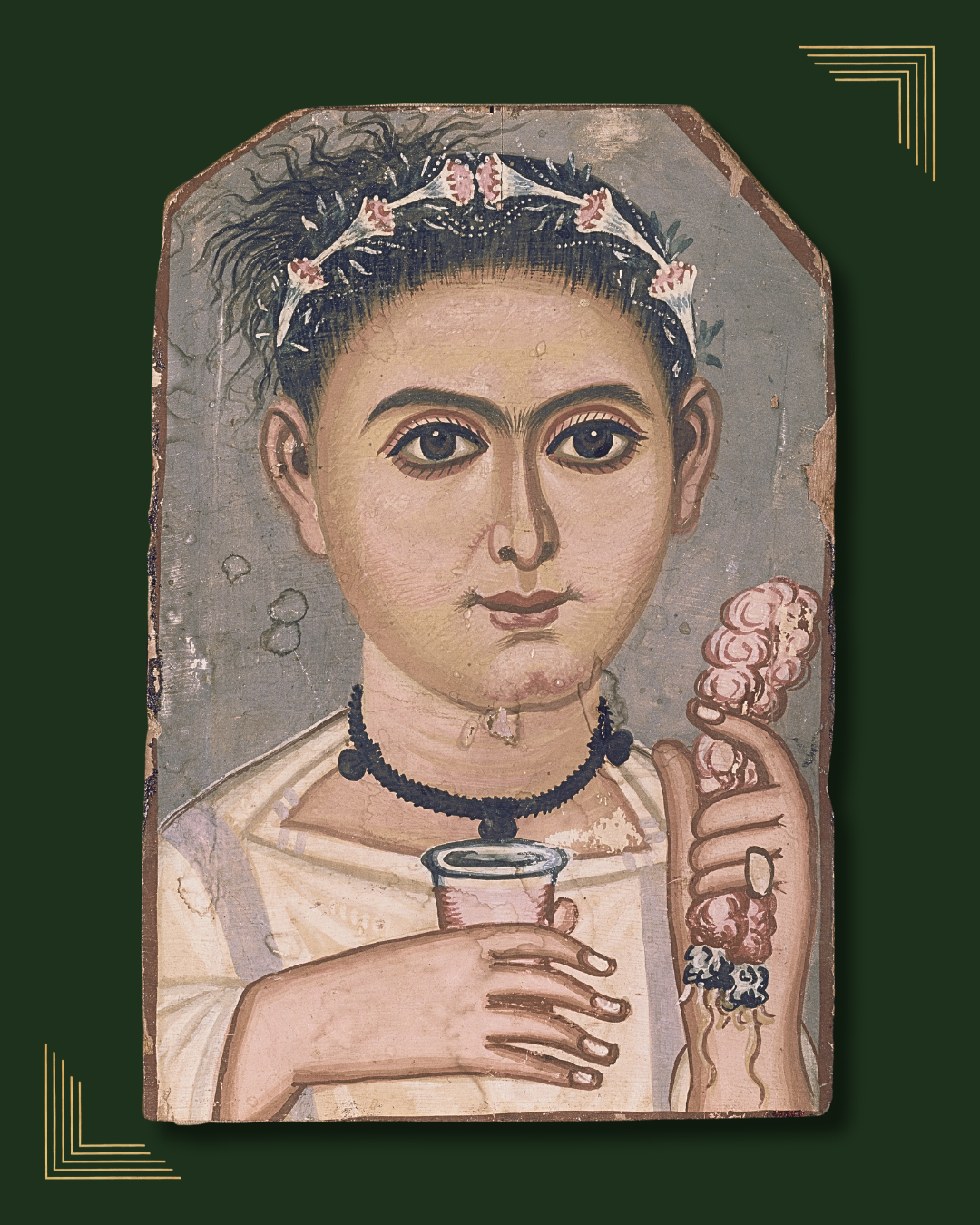
In this portrait entitled ‘Boy With A Floral Garland In His Hair’, we find a Fayum Mummy Portrait thought to be from Er-Rubayat in Egypt and dating to c.200 – 230 AD
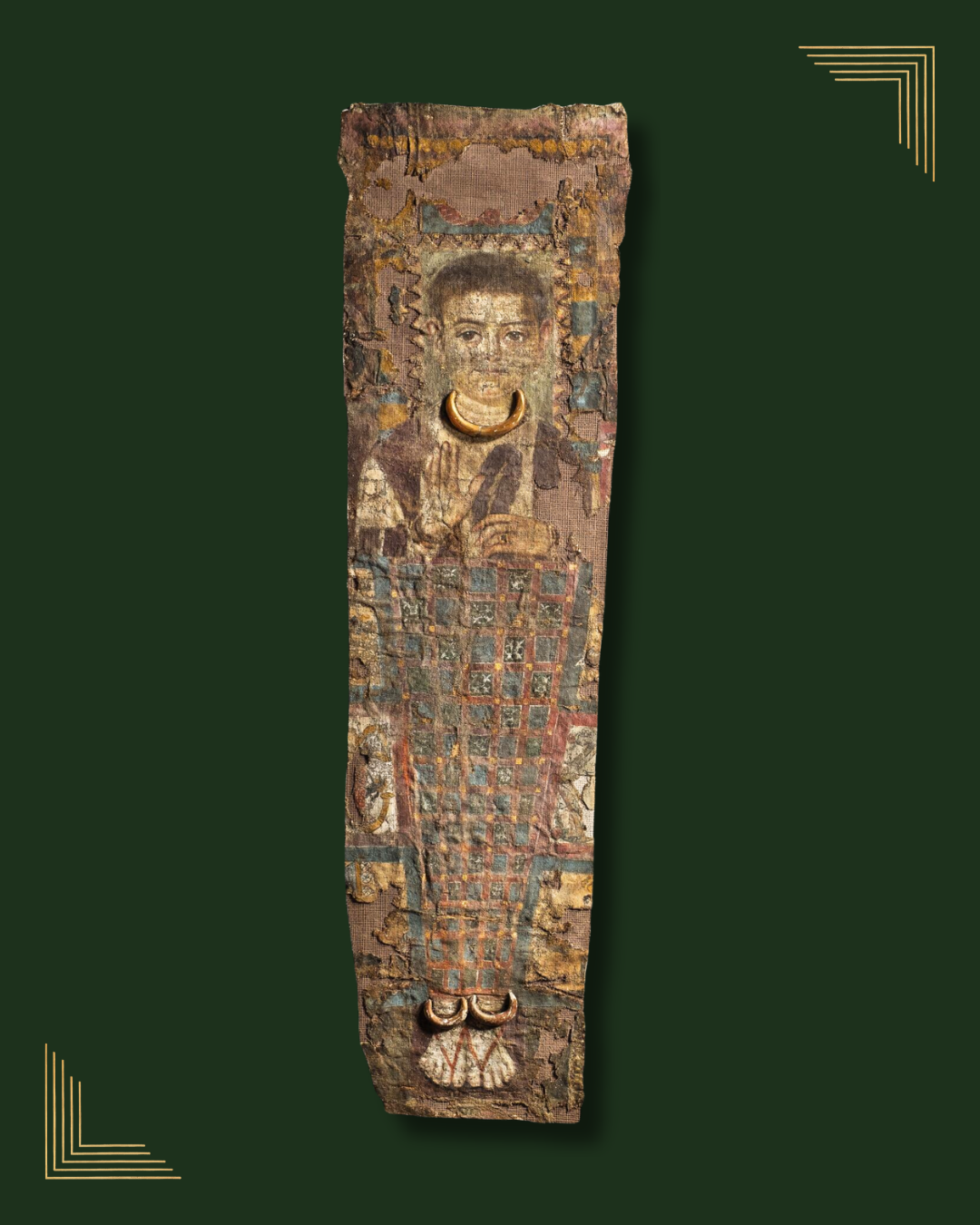
The ‘Fayum Portraits’ are a collection of ‘funerary paintings’ that were found in the Fayum region south of Cairo, in Egypt – now a major archaeological cemetery site – that date to the 1st – 3rd centuries AD. Excavations from this burial site, feature wealthy inhabitants who had been mummified and entombed along with their own painted portrait or mask.
The Fayum Portraits are considered unique due to the cross-fertilisation of cultures that are depicted within the paintings and burial styles. The paintings are considered Romano-Egyptian by provenance and represent typical Roman styles in terms of their hairstyles, clothing and jewellery. At the same time, they are attributed equally to the Egyptians (mummification was an Egyptian funerary practice), the Greeks (the portraits style of painting), as well as the Romans.
These portraits preserved the deceased’s ‘likeness’ for the afterlife – their purpose was to provide a lifelike image of the deceased, so that their spirit would be able to recognize that likeness and return to it each night. Therefore artefacts deemed important to the individual (such as their jewellery) were highlighted in great detail and considered necessary to aid their journey in the next life.
In this sense, the original intention of the Fayum Portraits was to allow the depicted to gain immortality – but for us, it provides a visual insight into the lives of the men, women and children they represent.
In this particular Fayum Portrait, you would be excused for initially thinking you are looking at a girl – with the depiction of florals, as well as pinks and pale lilac colours in the painting – but the style of jewellery and clothing tells us it’s a boy under the age of 14.
The youth is shown wearing a Roman-style white tunic with two pale lilac ‘clavi’ (vertical stripes) and pale lilac collar accents – which are the first clues that identify him as male.
In his hair he wears a pink floral crown, and in his left hand he holds a ‘bound’ garland of pink rose petals, while in his right hand he holds a cup made of blue glass, thought to contain red wine or perfume. Although the florals and the choice of colours may appear ‘feminine’ to a modern viewer – these items had specific funerary meanings.
The abundance of flowers in the portrait – both in his hair and in his hand – were symbolic of rebirth, since flowers die and come back to life each year – and the garland itself, in a funerary context, symbolised resurrection and happiness in the afterlife.
The floral hair wreath – often made of flowers like roses or laurels – was linked to the Egyptian concept of resurrection and symbolized rebirth and eternal life. Wreaths in general signified ‘victory’ – and in a funerary context represented triumph over death for the deceased and the successful transition to a divine state.
The bound garland was constructed of pink rose petals, strung or tied together, to form a compact folded wreath, secured with thread or fibre. Garlands of this kind are often found in Romano-Egyptian contexts, where fresh flowers were threaded into wreaths, collars and garlands to be worn on the body or carried during burial. Archaeological evidence from mummified remains shows that floral garlands could be placed around the neck, across the chest, or held in the hands of the deceased, reinforcing their role within funerary display.
The act of binding flowers represents human intervention – as the flowers were gathered, sorted and then fixed into form – so these were objects of intention. In this context, the bound garland functions as a symbol of rebirth, but also as a ritual object, specifically chosen by the deceased’s family for their journey into the afterlife.
The choice of rose petals was also deliberate as roses were closely associated with Romano-Egyptian funerary rites – representing seasonal renewal and cycles of life and death. Their ephemeral nature – blooming briefly before fading – made them particularly potent symbols within burial contexts, to reinforce the idea that renewal and rebirth followed death.
In the boy’s right hand he holds a ‘cup’ described to be of blue glass and holding either red wine or perfume as an ‘offering’ from the deceased to secure success in the afterlife. The depiction of the blue glass itself tells us of the boy’s high-born status – as blue glass was expensive. A cup of wine offered to the dead, was thought to provide sustenance for the deceased’s journey, as well as being symbolic of offerings he hoped to receive. A cup of perfume offered to the dead was symbolic of purification of the deceased. In conjunction with the flowers, both wine or perfume reflected the hope for resurrection.
Around his neck, the boy wears a dark neck-cord – probably of plaited leather – with three similarly coloured round ‘bulla’ pendants suspended from it. The ‘bulla’ is a well documented, lens-shaped, hollow container, worn as an amuletic pendant, and was such an integral part of ancient life that the Romans adopted the form from the Etruscans after the 3rd century BC, where it remained virtually unchanged throughout the Roman period. Although not restricted to children during Etruscan times, the bulla’s role in Roman society became increasingly child-specific.
The bulla had great importance in the lives of young Roman male citizens, who wore this particular pendant type from infancy as both a symbol of ‘free birth’ and an amulet to ward off evil – hence telling us that this is a Fayum Portrait of a boy. In Roman times, a newborn baby was welcomed into the family by the father, who placed an amulet around the child’s neck at a ceremonial ‘acceptance’. These were worn throughout childhood before being ceremoniously dismissed upon reaching adulthood – around 14 to 17 years for boys when they adopted the ‘toga virilis’ – hence telling us that since the boy is wearing his bulla, he must be under the age of 14.
The material of the bulla further signalled social status, whereby gold bullae were reserved for the noble, and leather bullae were worn by the sons of freedmen. In this portrait, the pendants are painted in the same tone as the cord, suggesting that they are made from leather, therefore indicating the boy’s social position. The bullae represented protective tokens intended to ward off evil during childhood and this symbolism was also inteb=nded to be taken into the afterlife.
Displayed on the little finger of the boy’s left hand is a broad signet ring – painted in a pale cream colour – possibly to represent gold. Roman children of both sexes are documented to have worn rings from an early age. Finger rings were among the most common Roman jewellery types, worn as marks of dignity, as seals and later as tokens of betrothal. Stylistically, the ring in this painting can be described as a ‘signet ring’, defined by its flat top bezel – which could either be plain and free of dedication or engraved with a personal motif or inscription.
The depiction of the ring – worn on the little finger – tells us that signet rings were made in small sizes to fit the little fingers of Roman children. References indicate that after childhood Roman men wore no jewellery except for their signet ring, suggesting either that such rings were already in their possession prior to adulthood or emphasising that the signet ring was an important male jewellery type. Further evidence details how small signet rings with engraved bezels displaying talismanic symbols, were specifically intended for children, reinforcing their dual function as both markers of identity and protective devices.
Together – the bullae, the signet ring, the wreath, the garland and the offering cup – form a layered system of protection, identity and belief. The bulla amulets guard the boy’s body, the ring signifies status and personal identity, and the florals and offerings articulate hope for renewal and happiness in the afterlife.
Every item in this portrait has been lovingly chosen (or painted) to secure the success of this boy’s journey through the afterlife and to ensure the boy was victorious in his transition to a divine being.
References:
Fig 61: c.200 – 230 AD
Funerary Portrait Of A Young ‘Boy With A Floral Garland In His Hair’ – depicting the Fayum Mummy Portrait of a young boy from Er-Rubayat in Egypt wearing: a black plaited leather necklace with three leather bulla amulets and a gold signet ring on his left hand.
From Er-Rubayat, Egypt
Brooklyn Museum of Art, New York
Image available via:
Brooklyn Museum of Art, New York, Accession no. 41.848
https://www.brooklynmuseum.org/en-GB/objects/3458
Wikimedia Commons:
Selected literature:
McAleer: Children’s Jewellery In Europe: Traditions And Contemporaneity: PhD Diss Royal College of Art, 2003: p149 fig 61
Walker, (Ed): Ancient Faces: Mummy Portraits from Roman Egypt: 1997 / 2000: p84 fig 45