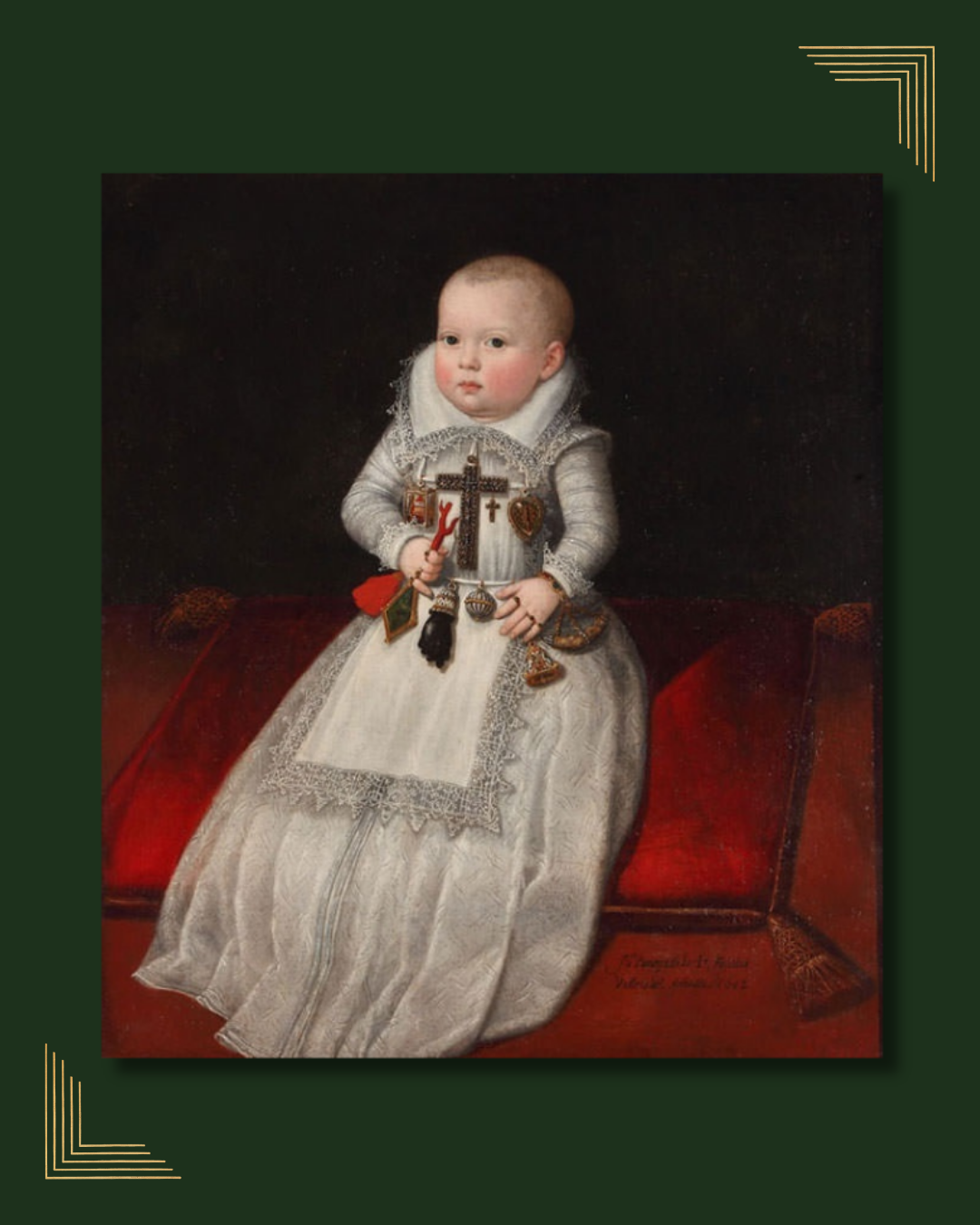
In two much quoted and illustrated early 17th century examples, the artist Juan Pantoja de la Cruz depicts the daughters of King Philip III of Spain, Anna (born 1601 – Fig 170) and Maria Anna (born 1606 – Fig 171), adorned with numerous amulets and talismans.
In this earlier portrait – Anna, at age one in 1602 – wears, in the middle of her chest, a large jewelled cross hung from her collar which has a smaller cross suspended from one of its arms. Also on her bodice is a memento box, probably made from rock crystal and a heart shaped amulet perhaps containing an eye. A pale cord encircles her waist with an animal foot, a clenched fist, a spherical pomander, a bell, and a horn attached.
In her hand, Anna clasps a branch of coral mounted on a diamond-shaped teething stick or rattle, and on each hand she wears three jewelled rings as well as a jewelled bracelet on her left wrist.
In the later portrait dated 1607 (Fig 171), Anna’s one year old sister Maria Anna, is adorned similarly to that of her sibling. Maria Anna wears a heavy linked chain looped up to a large brooch or pendant attached to the collar of her dress which is decorated with jewels forming the initial ‘M’.
A chain encircles Maria’s waist and from this, like in Anna’s portrait, are hung amulets in the form of a hand or animal foot, a horn, a pomander, a large circular object in a fancy setting, and a small circular object. Maria too holds an object, a clenched fist, in her right hand which is attached to a finer chain hung from the waist, and likewise a bell on a long chain is attached in the same way.
Anna and Maria are both portrayed with the identical amulets of bells, pomanders, hands and horns. Starting with the bells, which similarly to rattles, were commonly worn by young infants to avert the Evil Eye and evil spirits by frightening them away with their sound. The pomander on the other hand warded off unwanted influences by the omission of a protective smell or scent.
Pomanders were fashionable objects worn particularly by women during the 16th century and usually consisted of a pierced spherical container, which held mixtures of aromatic spices, herbs and perfumes. Apart from being primarily a perfume holder, the particular scents had beneficial magical or medical properties such as ‘Benzoin’, which was a popular incense that could be used to drive out evil spirits or to sooth and stimulate the body. The scent released by the pomander was thought particularly effective in guarding against many ailments – a tradition traced to religious customs in which incense was burned to free ‘sacred vapours’ – and the pomander would have been a protective device given to infants to protect against the various diseases of the time.
Hand amulets were regarded as talismans against the Evil Eye, and typically represented ‘hostile’ gestures which protected the wearer, both children and adults, by repelling unfriendly forces. Anna’s and Maria’s hand amulets, in the shape of a clenched fist, was known as the ‘fig-sign’ or ‘higa’ in Spain, ‘figue’ in France, and ‘fica’ in Italy, which was formed by the tip of the thumb protruding between the first and second fingers of a closed hand. This symbol had been used since Roman times, and then in all Latin countries – being made from many materials such as coral, crystal, gold, ivory, jet, stone, wood and today even in plastic – as an insulting signal, although its actual meaning is said to be confusing.
The higa is associated with the ‘fig’ whose meaning combined masculine and feminine attributes: the fig leaf was male, representing lust, sex and the male sexual organ, whereas the fig itself denoted fertility and the female as a goddess or mother figure. In this sense, the form the hand makes is said to symbolise a sexual gesture in which the thumb becomes the penis inserted into the vagina – although the actual emphasis is on the female genitalia. This hand, a sign of female genitals and female sexuality, was used to divert Evil as the exposure of the female organs broke magic spells (by providing the evil influence with a distraction), and perhaps more specifically to children, it was also worn by female infants to promote future fertility.
Anna and Maria are both also adorned with horns which like the bells and higas, were further amulets thought to repel the Evil Eye. In Italy, for example, horn talisman, especially when worn around the neck of men, were regarded as powerful symbols of virility and sexual magnetism. Equally, the horn stood for the female attributes of the life-giving Mother Goddess and fertility, hence when worn by female children, symbolised their femininity and like the higa, their future fruitfulness to bear children.
Other notable objects worn by the infant Anna include a branch of coral, an animal foot, a heart-shaped amulet and a cross. The stick of coral guarded children against a multitude of ailments such as the Evil Eye, fascination, bewitching, witchcraft, spells, nightmares, fear, bleeding, infections, diseases, teething pains and prolonged the wearer’s life.
Anna’s animal foot, identified as a badger’s paw, was also thought to deter the Evil Eye. The symbolism of the badger itself was said to represent clumsiness, mischief, playfulness, slyness and deceit, hence, a badger amulet may have protected the wearer against such undesirable qualities.
The heart, on the other hand, was often worn to attract positive properties to the wearer, as it was regarded as a universal symbol of love and friendship. Heart amulets would usually have been made from red stones, and were also worn to prevent a person’s soul being stolen from the heart itself – without the soul, the body would not survive. The heart-soul was the ‘centre’ of the body and represented intellect and intuition, sometimes referred to as the ‘eye of the heart’. The fact that the heart-shaped amulet worn by the infant Anna might enclose an ‘eye’ symbol and is positioned over the child’s heart, illustrates that this powerful talisman not only attracted love and intelligence but protected her body and soul from evil forces.
Anna is further protected by another potent amulet, the large cross hanging in the middle of her chest. The cross, although primarily seen as a Christian religious icon, was actually an ancient amulet that dates to before the birth of Christ and was regarded as the most powerful protective symbol to guard against evils of all kinds. It was also very fashionable to wear such large jewelled pendant crosses in Spain at this time – a trend which continued throughout the 17th century.
Other items of religious jewellery were equally popular like reliquary pendants which were small receptacles used to contain or display a holy relic and may be a possible explanation for the box-shaped item worn on Anna’s chest. Relics of Christ or particular Saints (such as parts of their body or possessions) were seen as venerated objects of devotion and were often enclosed inside jewels, usually set in crystal, so that the relics could be viewed and worn on the person for their particular protective qualities. The shielding properties of such items would depend on the actual relic and the large brooch pinned to the bodice of Maria’s dress, for example, depicting the gem-set initial ‘M’ may actually be ‘M R’ which represented the initials of the Virgin Mary to form a ‘venera’ – another type of religious jewel that was worn in Spain during the 17th century.
References:
Fig 170: 1602
Portrait ‘Infanta Anna’ depicting the one year old daughter of King Philip III of Spain wearing amulets: a jewelled cross, a crystal memento box and a heart pendant adorn her bodice; an animal foot, a higa, a spherical pomander, a bell and a horn are hung from her waist; she holds a diamond-shaped teething stem set with a branch of coral. In addition, she wears three jewelled rings on each hand and a jewelled bracelet on her left wrist
Juan Pantoja de la Cruz, Spanish
Convent of Las Descalzas Reales, Madrid
Image available via:
Galeria de las Colecciones Reales, Accession no. 00612229
Wikimedia Commons:
https://commons.wikimedia.org/wiki/File:Juan_Pantoja_de_la_Cruz_020.jpg
Selected literature:
McAleer: Children’s Jewellery In Europe: Traditions And Contemporaneity: PhD Diss Royal College of Art, 2003: pp319-324 fig 170
Tait: Seven Thousand Years of Jewellery: 1986: p213 fig 528