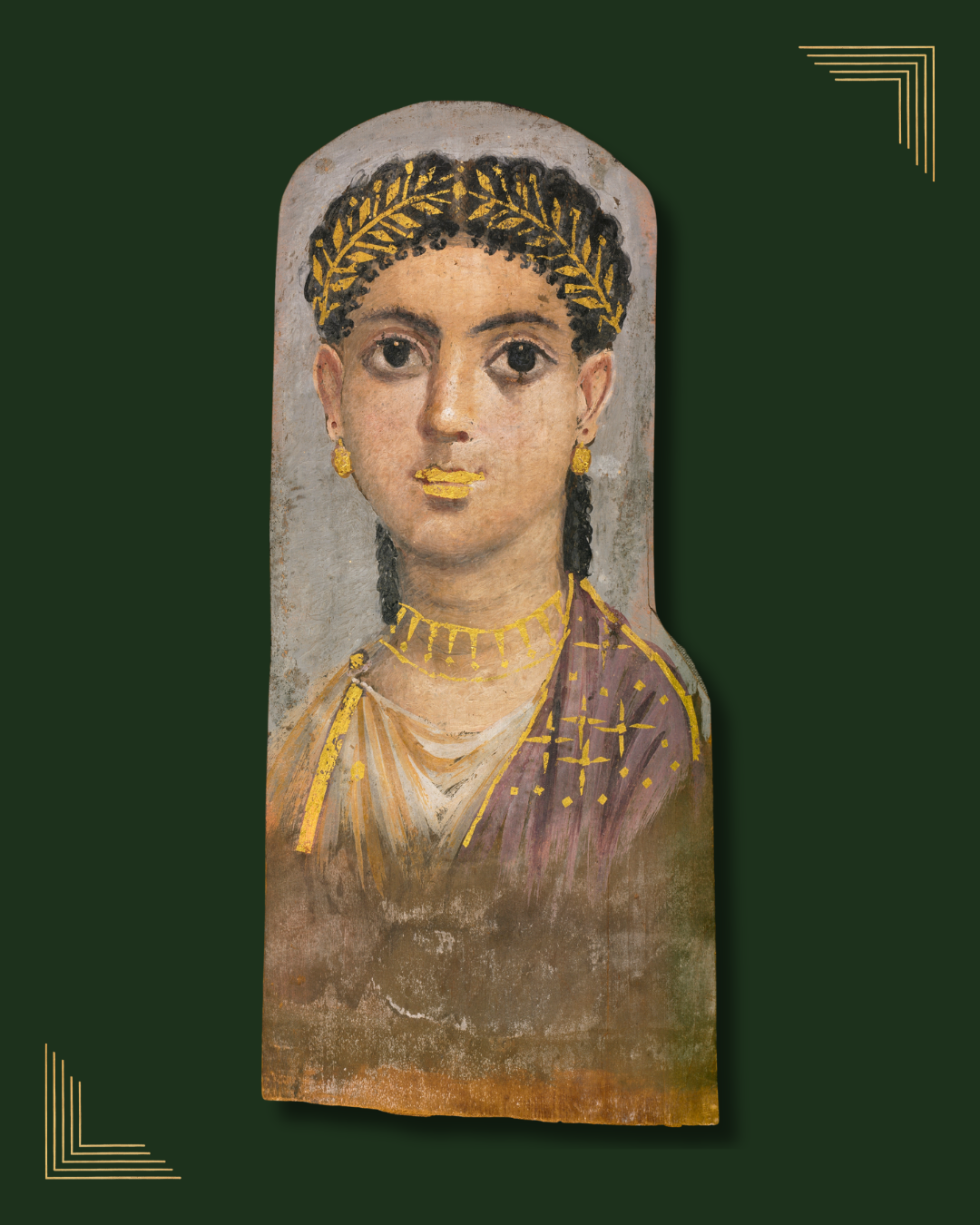
In this Fayum Mummy Portrait entitled ‘Funerary Portrait Of A Young Girl’ we see a girl with a youthful face whose image is beautifully embellished with highlights of gold.
The jewellery in this portrait is intended to represent gold through the application of gold leaf. The girl is adorned with a gold wreath in her hair, a pair of rectangular or square shaped gold earrings, a gold beaded necklace or choker and a gold clasp holding her clothing in place. The purple stripe of her clothing is also ornately decorated with a dot and star-like pattern – again highlighted in gold.
Dating to the 1st – 3rd centuries AD – the ‘Fayum Portraits’ are a unique collection of ‘funerary paintings’ that were found in the Fayum region south of Cairo, in Egypt. They were excavated from a burial site, whose wealthy inhabitants had been mummified and entombed along with their own portrait or mask.
Romano-Egyptian by provenance – they are considered to represent typical Roman styles in terms of their hairstyles, clothing and jewellery. Although they are attributed equally to the Egyptians (mummification was an Egyptian funerary practice), the Greeks (the portraits style of painting), as well as the Romans.
These portraits provided a ‘facial representation’ which was used to preserve the deceased’s likeness for the afterlife. Their purpose was to provide a lifelike image of the deceased so that their spirit would be able to recognize that likeness and return to it each night. Therefore artefacts that were deemed to be important to the individual (such as their jewellery) were also highlighted in great detail – as these were also considered necessary to aid their journey in the next life.
So although the original intention of the paintings was to allow the depicted to gain a sense of immortality – it provides us a visual insight into the lives of the men, women and children they represent.
For our ‘young girl’ – her ‘exact’ age is difficult to determine – and so it is possible that she was ‘on the verge’ of adulthood. For noble Roman females this transition could occur as early as 12 years of age (into their early teens) – when it became acceptable for them to marry.
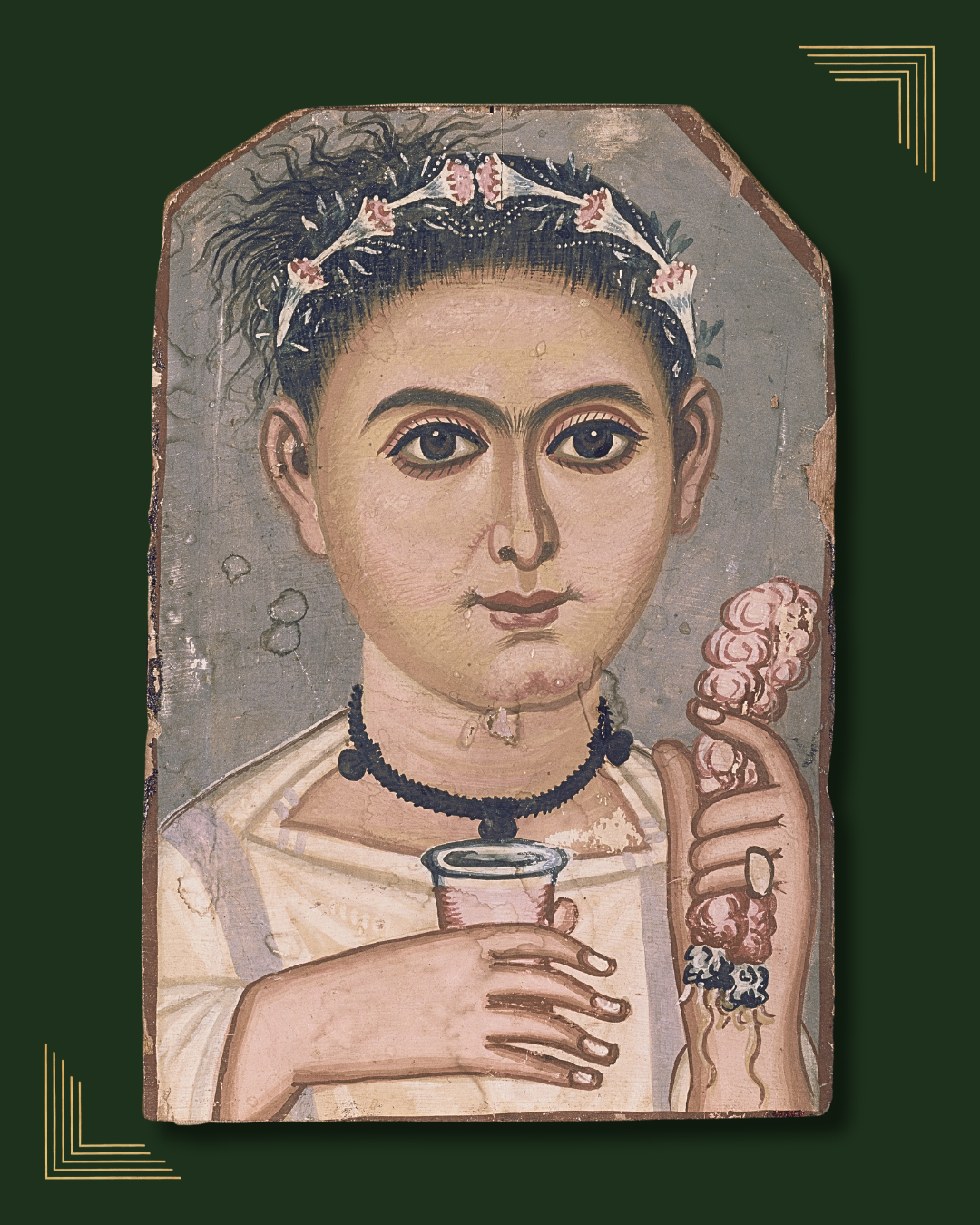
The portrayal of children as adults however, is a common occurrence in the Fayum Mummy portraits and suggests two things:
- Firstly that the slightly older child may not have been considered any different to their adult counterparts;
- But secondly, that the portrayal of children to ‘look older’ in these portraits – which were of course funerary in nature – allowed the child to attain ‘maturity’ in death. Something they would no longer achieve in life.
If we look at the beautiful gold detailing in this portrait – we learn more about the story behind this painting and gain an insight into how a family wanted their child to be portrayed. You may think that the gold highlights are simply decorative elements – and yes on one hand they are decorative and on another they alluded to status and wealth – but they were ‘also’ purposefully applied. In fact it’s noted that the use of ‘gold leaf highlights’ within the Fayum Portraits is not typical and so, in death, this girl’s ‘adornment’ was a declaration from her family, telling us that they took great care to make sure her ‘likeness’ would ‘live on’.
In this portrait, the gold gliding has been applied to the young girl’s lips, wreath, jewellery and clothing. The symbolic purpose of the gold was to help this child gain immortality and for her spirit to transform, in death, into a blessed spirit, or ‘akh’ – a being of light.
Furthermore, the application of the gold on the girls lips is said to be ‘rare’ – again to represent the deceased becoming a glorified eternal being (or akh) which was only possible for those who lived ‘virtuously’. And may also have been a reference to what was known as the ‘Opening Of The Mouth’ ceremony. This was an Egyptian ritual, performed on mummies, that restored the deceased’s senses (their ability to see, hear, smell, speak and eat) for their journey into the afterlife.
Gold, in general, symbolised eternity in ancient Egyptian and Roman traditions, and its use within the Fayum portraits did indicate that the depicted were of a high status – but it was also hoped that these ‘likenesses’ would help them gain divine favor in the afterlife. And so for the young girl depicted here – her family wanted her to become ‘more than mortal’, they wanted to ensure she would become a blessed being of eternal light.
Within this portrait, each of the gold elements has distinctive symbolic meaning:
- → The girl’s dark hair is decorated with a gold wreath. Her hairstyle is said to be typically fashionable with tiny curls across her forehead and 2 longer curls that hang each side of her neck to her shoulders.
- Wreaths were a symbol of eternity and divine victory, and in a funerary context meant victory over death and hence, a safe journey into the afterlife
- → She wears a pair of earrings consisting of little dots with rectangular drops that have been highlighted in gold.
- Gold earrings signify status, but the Romans also believed that earrings repelled evil spirits that could enter the body through the ears and possess the mind.
- → She wears a necklace entirely of gold leaf in a choker style with a geometric pattern.
- This implies that the necklace has been added to the portrait – perhaps a symbol of status but perhaps also to represent adult fashions, and therefore helping the child gain ‘maturity’ in the afterlife.
- → As mentioned her gilded lips – noted to be a rare addition in Fayum Portraits are described as being an ‘achievement’ technically because of the curved nature of the lips – since other gold leaf highlights were naturally cut in a more angular fashion.
- And whilst we know that this represented ‘the glory of the eternal akh’ for those who had been virtuous in life – it also highlights the importance of this particular application of gilding drawing focus to the lips.
- → Even her clothing is beautifully gilded.
- The ‘clavus’ or stripe on the left is completely highlighted by a gold line. There is a gold clasp on her shoulder – and on the right, the purple of her cloak, is ornately decorated with a ‘spangle’ of stars and dots. Again this is a nod to her status – especially the gold clasp – as using a ‘clasp’ to fasten clothing (rather than simple pins) symbolised wealth.
- For Romans the colour purple was a symbol of power and status as the dye was expensive and rare and typically reserved by law for emperors and high-ranking officials. Freeborn children did wear a ‘toga praetexta’ which had a distinctive purple border. Whilst this also signified status – the purple stripe was also a form of protection, and the colour itself had apotropaic quality and the ability to ward off evil.
And so as you can see, every touch of gold found within this portrait carried its own important symbolic message. And every brush stroke that was purposefully and thoughtfully applied, signified her family’s act of love to make sure this young girl’s memory – and spirit – would have the best possible chance of achieving immortality in the afterlife!
And now as we gaze upon this painting and this girl’s ‘likeness’ stares back at us – she can rest easy knowing that some 2000 years later she is STILL a beautiful and virtuous being of light…and that her spirit continues to live on!
References:
Fig 71: c.25 – 37 AD
Fayum Portrait of a Girl wearing a gold hair wreath, a pair of gold earrings, a gold beaded necklace and a gold clasp
Hawara, Egypt
Cleveland Museum of Art, Ohio
Image available via:
Cleveland Museum of Art, Accession no. 1971.137
https://www.clevelandart.org/art/1971.137
Wikimedia Commons:
https://commons.wikimedia.org/wiki/File:Clevelandart_1971.137.jpg
Selected literature:
McAleer: Children’s Jewellery In Europe: Traditions And Contemporaneity: PhD Diss Royal College of Art, 2003: pp157-158 fig 71
Doxiadis: The Mysterious Fayum Portraits: Faces from Ancient Egypt: 1995: p68 fig 55