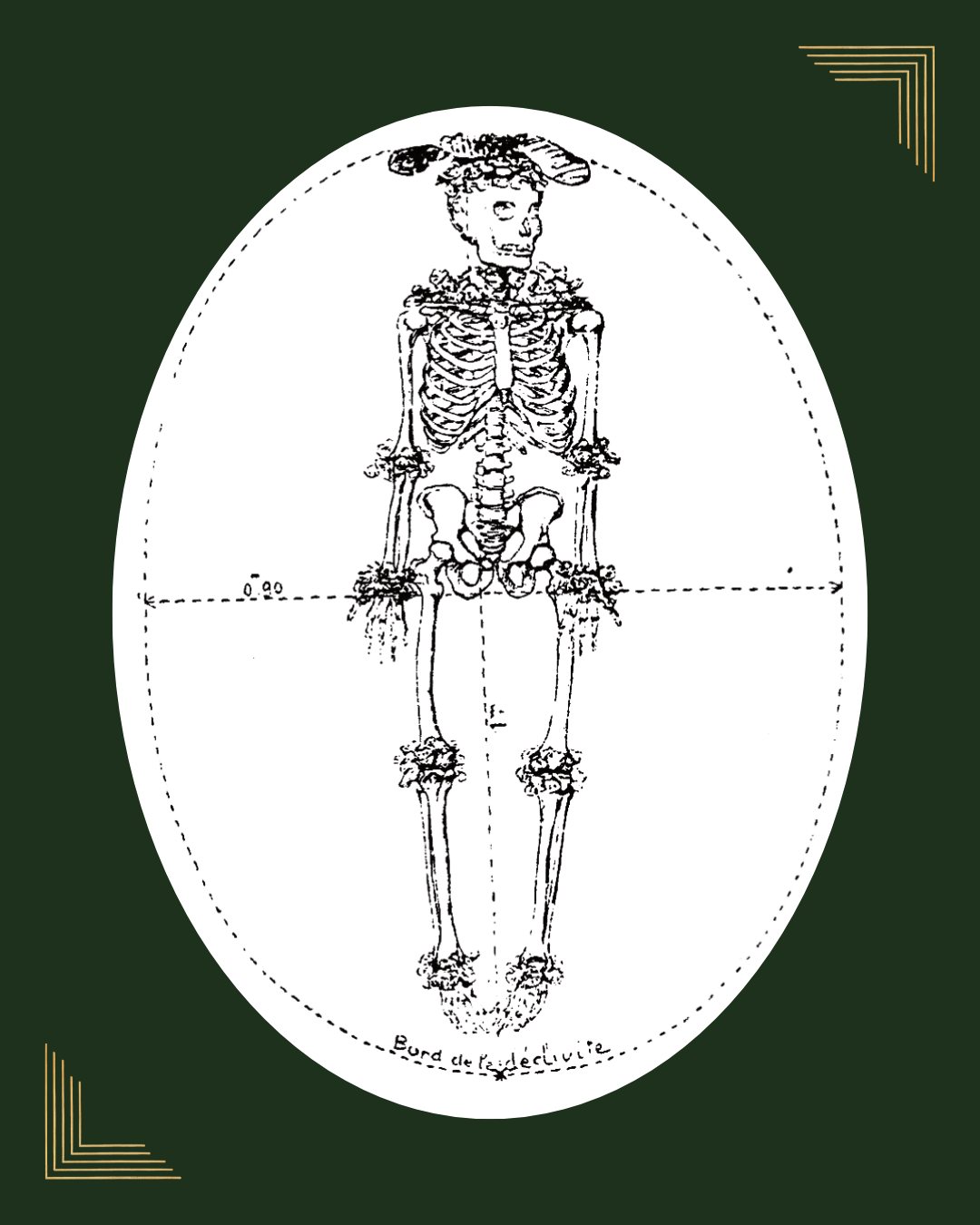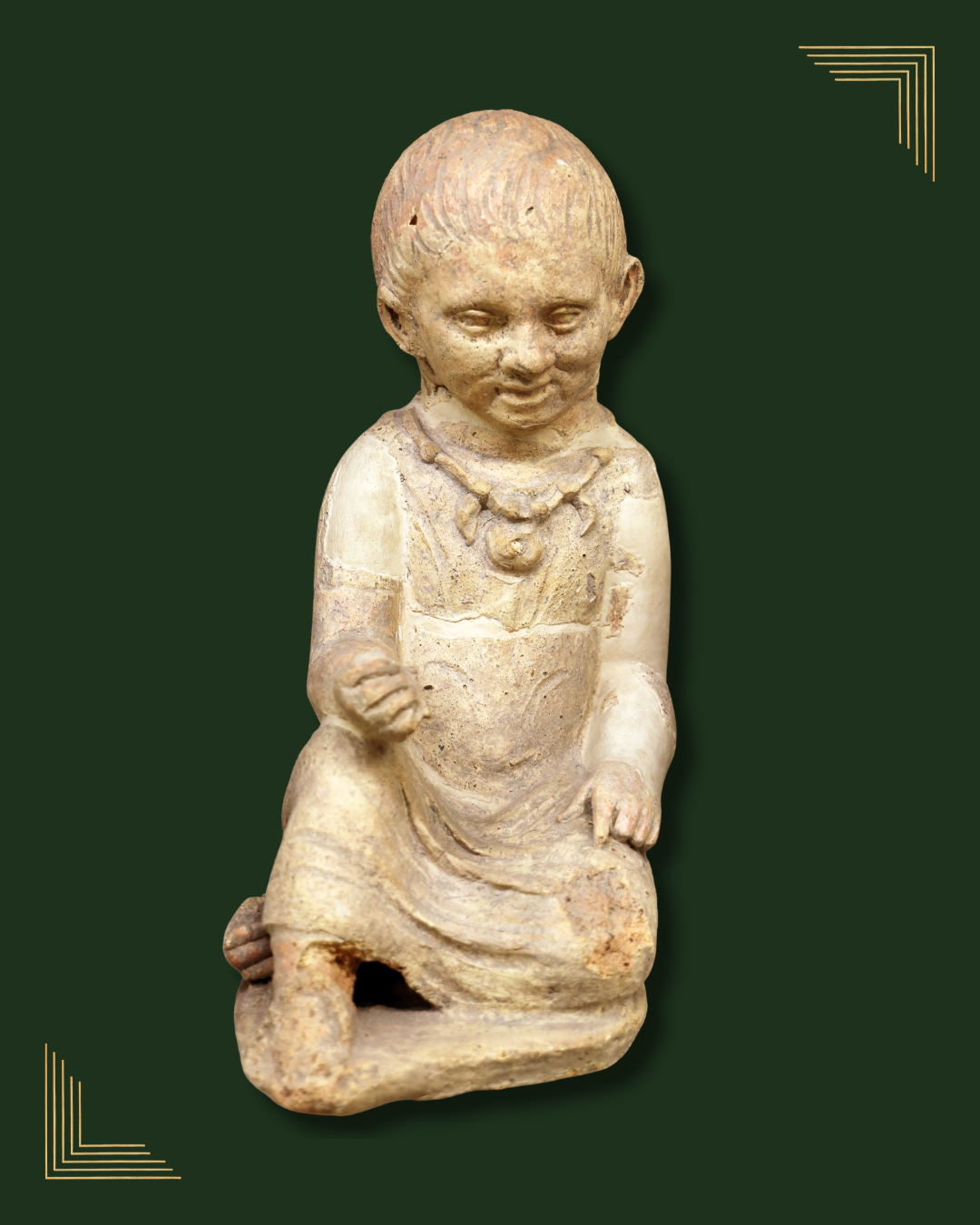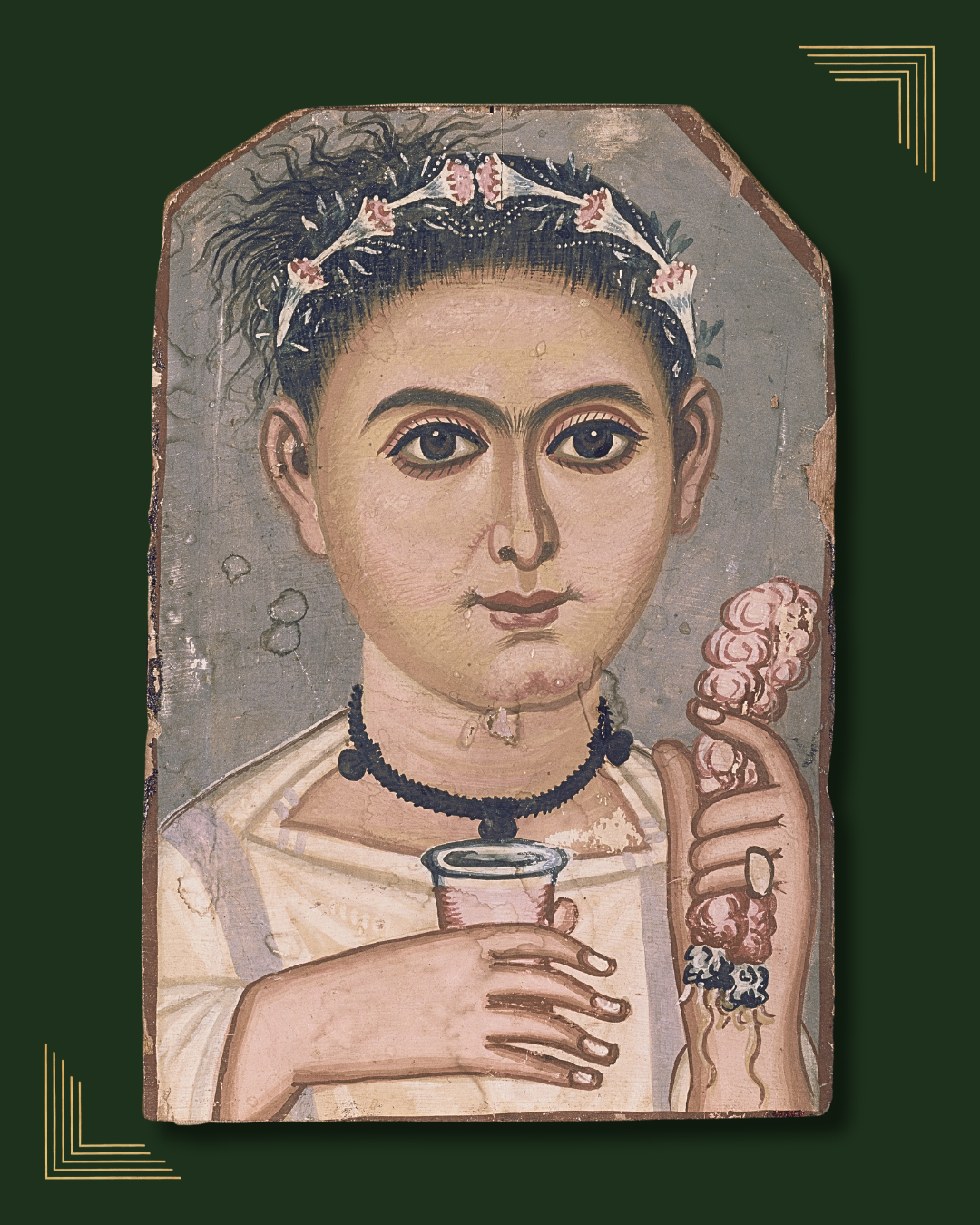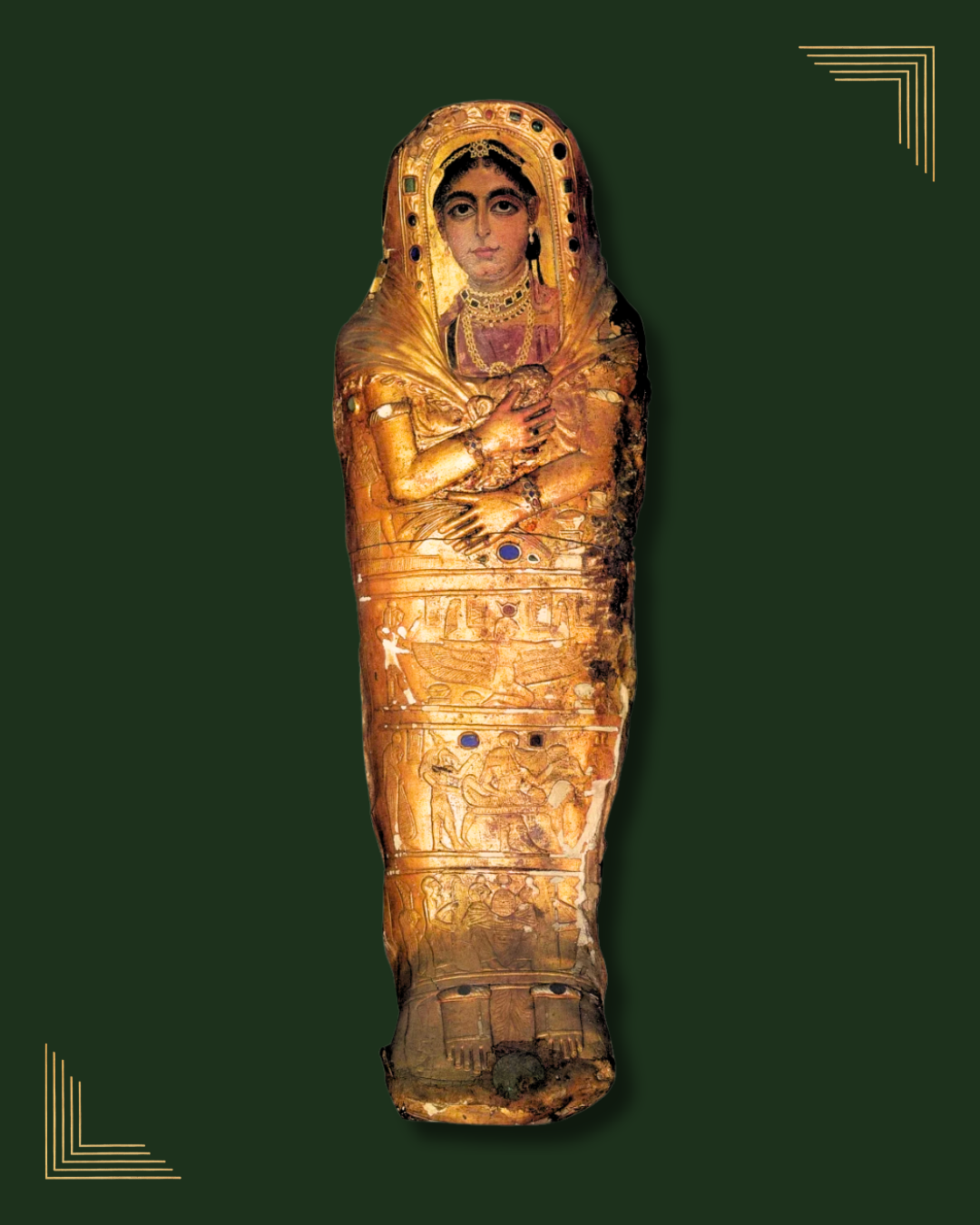
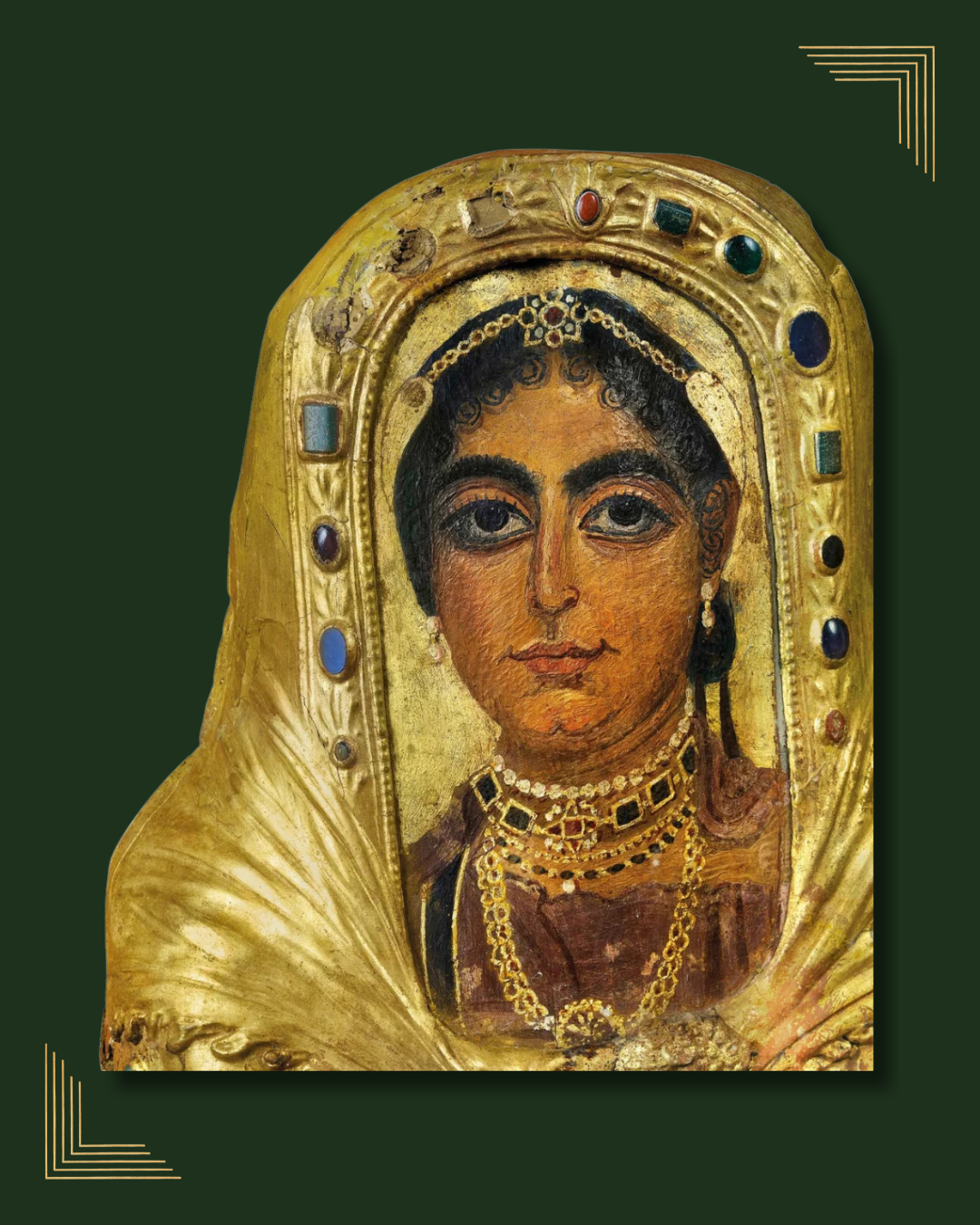
One of the most ornate and lavishly decorated Fayum Mummies from my research – includes a portrait and full-length mummy case belonging to a child whose face is painted to resemble that of a woman. The mummy, known as ‘The Golden Girl’ dates to 125 – 150 AD, and belongs to a seven – ten year old child (said to have been determined by the length of the mummy itself, along with the size of the arms and hands modelled on the case). The little girl holds a flower garland in her right hand and wheat in her left hand, both representing success in life after death. She bares her shoulder to associate herself with Aphrodite, for beauty and fruitfulness, and the appearance of a Horus or Isis-lock on the left side of her hair, confirms that this is the mummy of a girl under the age of twelve.
In the Golden Girl’s portrait, she is adorned with a hair ornament, a pair of earrings and five necklaces. In addition, on the case of the mummy itself, she wears two bracelets, two arm-bracelets, three rings and two anklets, all of which are modelled in stucco and are extremely detailed in their depiction. Her hair accessory is described as being gold and consists of a central ‘rosette’, composed of gems and pearls, with a chain attached to a band that passes around the child’s head. Each earring is composed of two large pearls with a smaller stone or bar in between. The first and shortest necklace is a choker constructed entirely of pearls threaded on a gold chain. The most ornate necklace, again of choker length, is described as having a central star-shaped ornament of amethyst-like purple stones, surrounded by pearls, which is attached to a chain of large, rectangular, gold-mounted, emerald-green stones. The third necklace, slightly longer in length, consists of alternating gold and small purple beads imitating amethysts. The fourth has a single pearl pendant suspended from a string of alternating small gold and dark emerald-green oval beads. The fifth and longest necklace, reaching the child’s chest, consists of a heavy double chain that is jewelled with red stones along with a large circular jewelled rosette, suspended at the front.
The bracelets and rings, not part of the portrait, are instead modelled on the girl’s arms and feet and form part of the mummy casing – like the surface of the case itself, these are heavily jewelled. The Golden Girl wears an identical bracelet on each wrist constructed from a broad band of twisted gold, with a central flower motif set with different coloured stones. Her arm and ankle bracelets are again identical pairs of broad twisted gold bands with one large central oval-shaped stone – although the stones themselves are missing from the arm bracelets. She wears three gemstone rings, one on the third finger of her right hand, one on the little finger of her left hand, and a third on the top joint of the third finger of her left hand.
As it was the fashion for Roman adults to be laden with jewellery, it is not surprising that children were adorned in a similar manner. The fact that this young girl was painted as an adult may simply have been the artist’s interpretation of the child, but more importantly, was a way of ensuring that the child attained maturity in death and hence in the afterlife. This particular example is described as having iconic values, due to the depiction of highly elaborate jewellery and the amount of gold and gold leaf on display – gilding was applied in mummy portraits to ensure immortality, and was also thought to convey the deceased’s divinity. Whatever the reason, it is obvious that the child must have belonged to a very wealthy family – one that thought her important enough to be buried in such an extravagant manner.
References:
This artefact is referenced here as part of a broader visual and textual study of children’s jewellery in historical art.
Fig 73: c.125 – 150 AD
Funerary Portrait And Full-Length Mummy Case Of A 7 – 10 Year Old Girl Known As ‘The Golden Girl’ Wearing Gold Jewellery: A Pearl And Gem-Set Hair Ornament, Pearl Earrings, Five Pearl And Gem-Set Necklaces; Stucco-Relief Pairs Of Gem-Set Bracelets, Armlets And Anklets; And Three Gem-Set Rings.
From Hawara, Egypt
Egyptian Museum, Cairo – CG 33216
Published in:
McAleer: Children’s Jewellery In Europe: Traditions And Contemporaneity: PhD Diss Royal College of Art, 2003: pp160-162 fig 73
Doxiadis: The Mysterious Fayum Portraits: Faces from Ancient Egypt: 1995: p71 fig 59 – 60 & p203