The most abundant resource for studying the development of children’s jewellery dates from the Italian Renaissance at the end of the 15th century, and is heralded by the arrival of the innovative ‘portrait’ – non-religious representational paintings of individuals. Prior to this, religious themes – especially ‘Madonna and Child’ paintings – dominated the canvas but by the 16th century, the fashion for portraiture had quickly engulfed the majority of Europe.
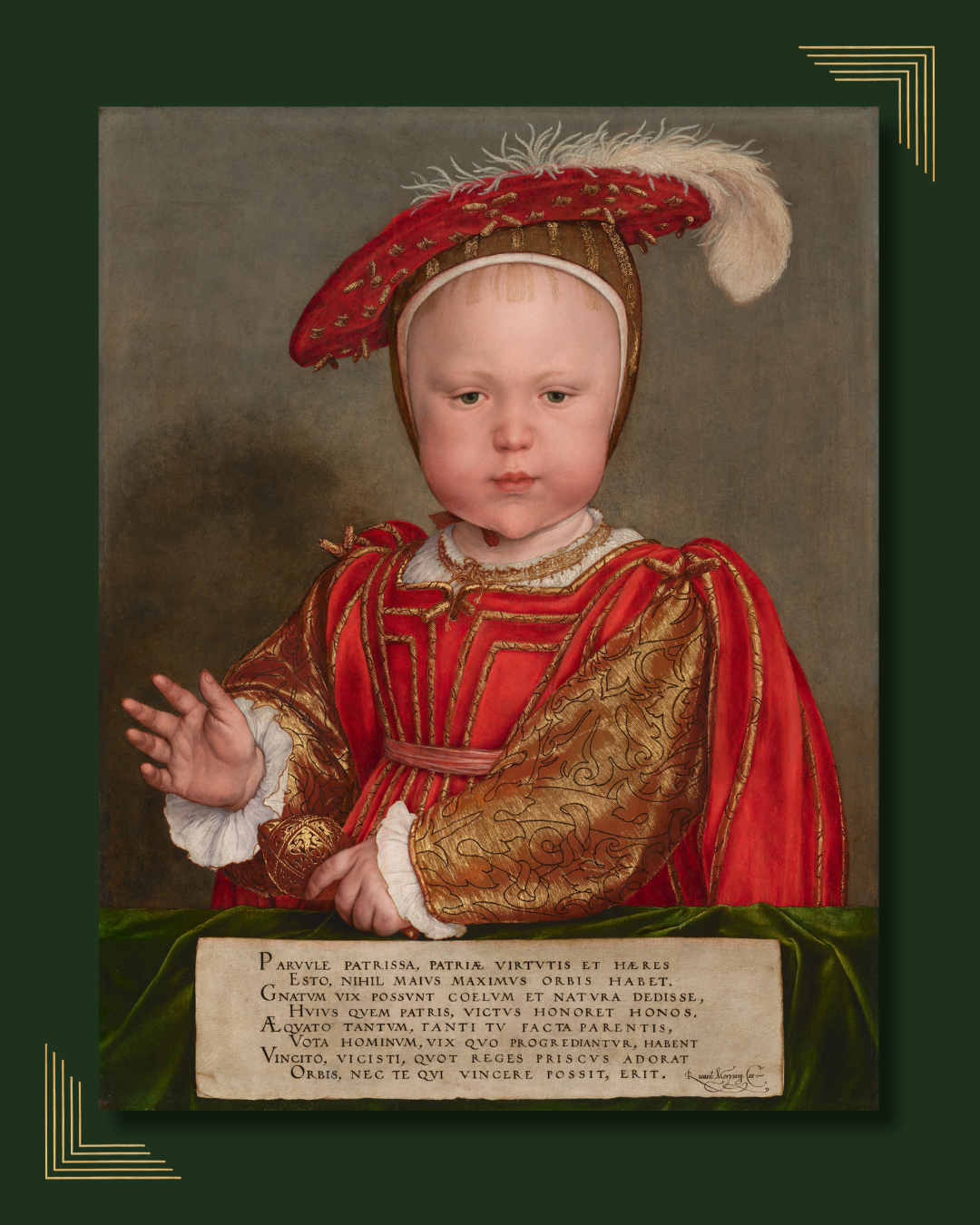
In Britain, the earliest portrayal of a child, as a painting’s sole subject, is said to be Hans Holbein’s 1539 depiction of the one year old Edward VI – who was born in 1537. Edward was the ONLY legitimate son of King Henry VIII of England by his third wife, Jane Seymour. So there was a lot of hope placed upon this child – who would one day outlive Henry VIII and become King.
This painting was thought to have been presented to Henry VIII as a New Year’s gift, in celebration of the royal ‘heir’.
The inscription reads: Little one, emulate thy father and be the heir of his virtue; the world contains nothing greater. Heaven and earth could scarcely produce a son whose glory would surpass that of such a father. Do thou but equal the deeds of thy parent and men can ask no more. Shouldst thou surpass him, thou hast outstript all kings the world has revered in ages past.
It is described as the precursor of what became, in Britain, a separate genre in portrait painting by the end of the 16th century – the child portrait. Although this suggests that children’s portraits took longer to materialise than their adult counterparts, British portraiture itself did not fully develop until the 16th century and paintings that include children, in both a religious and non-religious context, do exist from other European countries prior to this date.
The ‘portrait’ was known to be an expensive article, afforded only by the aristocracy, the gentry and the rich merchant classes. Not only did the portrait catalogue a detailed representation of its subjects, but the image was purposefully posed to convey other attributes such as political position and social status. Patrons were dressed in their best and inherently this meant that they were adorned in the most fashionable attire – stylish clothing and extravagant jewellery.
The portrayal of children was no exception and although younger subjects may not have held independent rank, an artist would have considered the families standing in society and adhered to prevalent dress codes, in order to honour the parents, for example, in his final depiction of their child.
The painting of the young Edward VI is exemplar of its time-frame and is described to represent a ‘miniature adult’ who was ‘richly’ dressed in the appropriate aristocratic male clothing of the period.
Descriptions of this painting often describe Edward to be holding a ‘sceptre’ in his left hand to signify his ‘regalness’, whilst he raises his right hand to represent a ‘gesture of blessing’. However he’s ‘actually’ holding a gold baby rattle with ornately pierced details.
Rattles were regarded at this time to be highly decorative objects of personal adornment, typically suspended on chains or ribbons worn around the child’s waist or neck. As well as being fashionable, rattles were given to children to protect against evils and the evil eye – where the noise of the rattles was literally used to scare off said evil.
Edward VI was said to have been a ‘sickly’ and frail child (although there is some debate over this) – so the fact he’s holding a rattle holds even more significance – in that the ‘heir to the throne’ needed protection from both the illness AND any evils that might befall him!
He outlived Henry VIII becoming King at the age 9 – but he later died before he was 16.
As well as being the first solo painting of a child in England, this could be the FIRST English portrait of a child depicted with an item of jewellery!
References:
Fig 99: c.1538 / 1539
Portrait of Edward VI as a one year old baby holding an ornate gold pierced rattle (said to be the first solo portrait of a child in England).
Hans Holbein the Younger, German
The National Gallery of Art, Washington
Image available via:
The National Gallery of Art (Washington), Accession no. 1937.1.64
https://www.nga.gov/artworks/71-edward-vi-child
Wikimedia Commons:
Selected literature:
McAleer: Children’s Jewellery In Europe: Traditions And Contemporaneity: PhD Diss Royal College of Art, 2003: pp236-239 fig 99
Kevill-Davies: Yesterday’s Children: The Antiques and History of Childcare: 1991 / 1998: p301 fig 303