Coral has been used as an amulet to guard children against the Evil Eye since Ancient times, and from the Medieval period, was renowned for its protection of babies against certain ‘infantile’ illness, notably teething.
Amuletic and functional ‘coral teethers’ became a major part of the child’s wardrobe during the 16th and 17th centuries – and so these weren’t solely confined to portraits, but existed in the everyday lives of childhood. These ‘stems of coral’ played such a vital part in a young infant’s life, that they were recognised as a most appropriate teething accessory and hence became a precious ‘jewel’, made of ‘precious’ materials – not only in terms of value but also in symbolic significance.
Coral further progressed in popularity during the 17th century when the coral ‘stem’ was included as a talismanic teething aid within baby’s rattles.
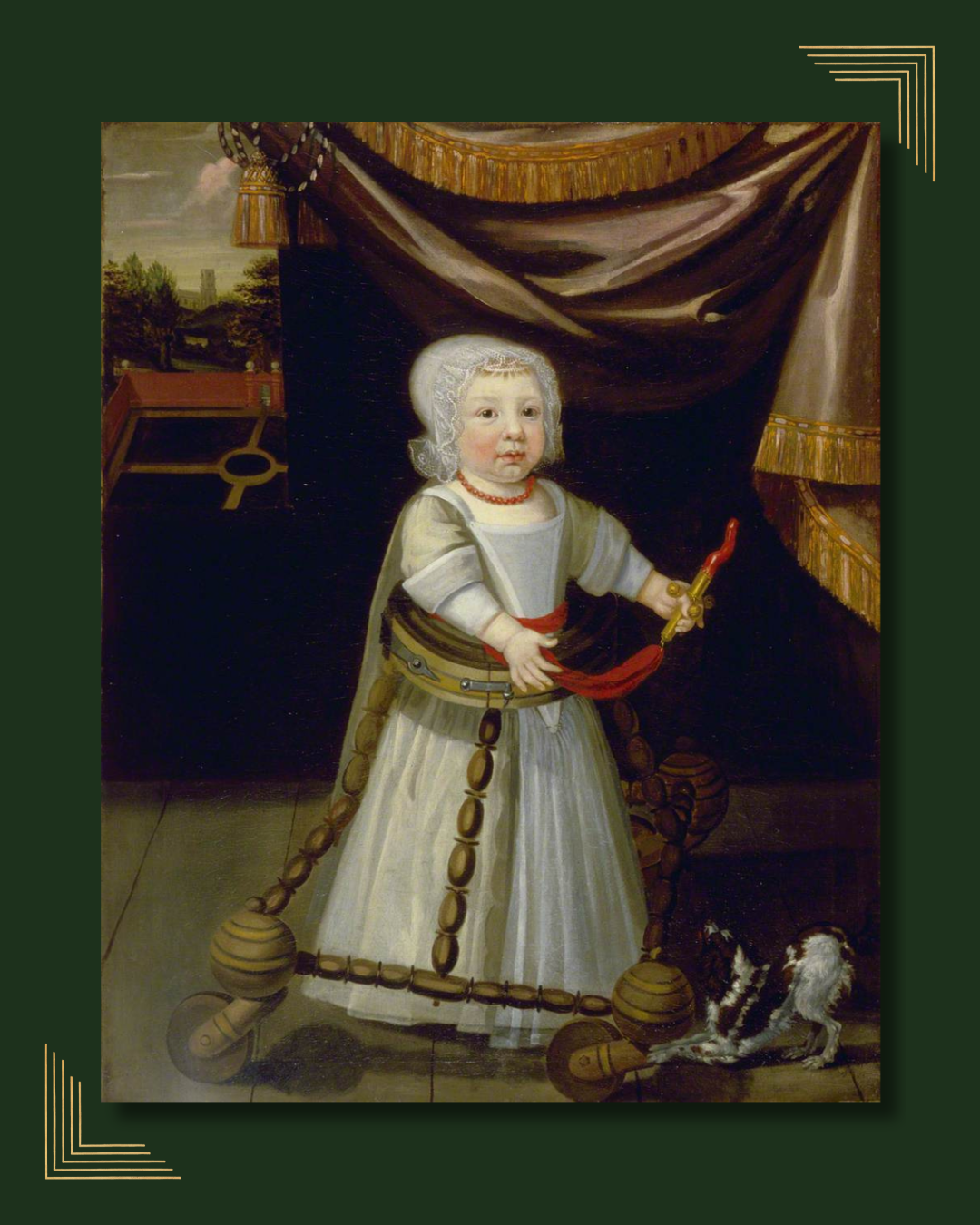
In this 17th century English painting dated 1650 – 1660, a simplistic rattle is depicted consisting of a ‘stick’ or stem of coral mounted on a long gold ‘shaft’ decorated with three or four large gold bells. The rattle is attached to the child by a thick red ribbon encircling the waist.
The artist of this painting is unknown, but it is documented within the Norwich Castle Museum’s collections that this portrait depicts a boy. We know that the boy is an infant under around 1 years of age – as he is depicted using his ‘baby walker’. This was a wooden structure, known as a ‘going stool’ or ‘standing stool’, that helped toddlers learn to walk after they had been ‘released from swaddling’ – which usually started around 9 to 12 months or when they showed signs of wanting to stand.
The inclusion of bells on this rattle – was another device to avert the Evil Eye, whilst the actual noise of the bells created a ‘rattling’ effect to frighten off evil spirits. The bell’s properties, combined with coral’s similar defensive qualities produced a powerful amuletic jewel that was given to babies and young infants to forestall the ‘evils’ of teething.
In this portrait, the infant boy is additionally protected by a necklace of amuletic coral beads worn close around the neck. In fact during the late 17th century, for example, a Sir Thomas Browne was noted to have ‘cited’ Pliny’s book of Natural History (1st Century AD), commenting that if children wore coral around the neck this may have been ‘superstitiously founded as presumed an amulet or defensative against fascination…’.
Furthermore, various lapidary books go on to document coral as a talisman to guard children – especially the first born son – against ‘fascination’. In fact Pliny the Elder (the Latin writer and scholar) wrote that – branches of coral tied to an infant’s neck, protected them against ‘fascination’. And ‘fascination’ – associated with the Evil Eye and witchcraft – was blamed for various symptoms ranging from paralysis of the will to violent illness or death. In the mid-17th century, a J. Freake defined this condition in his book ‘Agrippa’s Occult Philos[ophy]’ as ‘a binding which comes from the spirit of the Witch, through the eyes of him that is bewitched, entering to his heart’.
Although the rattle itself had been in existence since at least 1200 BC, pictorial and written evidence suggests that the inclusion of coral as an amuletic teething material was not apparent before the 17th century. However as coral became more renowned as a potent charm to relieve teething pains, its popularity soared throughout the next few centuries, and can still be found within more modern baby’s teething rings right through to the 20th century.
Rattles that incorporated coral, generally included bells and sometimes a whistle (also an Evil Eye protector) which when combined, were famed for their abilities to aid teething, guard against the Evil Eye (as well as the ‘evil’s’ of teething), and frighten off evil spirits.
Many examples of these artefacts, generally referred to as ‘corals’, ‘coral and bells’ or ‘whistles and bells’, have survived, dating from around the 18th century, and highlight that such jewels, were very real ornaments in the lives of young children. Whether or not all children made use of their rattles is another matter as Joseph Addison, 1672 – 1719, explained in a quote from ‘The Spectator’: ‘I threw away my rattle before I was two months old, and would not make use of my coral until they had taken the bells away from it’.
So you can see that within this belief – the infant boy is adorned with a coral necklace (perhaps to symbolise he’s a first born son) to protect him against ailments like ‘fascination’ and is holding his coral rattle as protection against the evil eye and the ‘evils’ of teething. Furthermore,the artist has used the rich colour of the coral necklace, coral stem and the colour of the ribbon to draw our eye specifically to these items – which stand out in contrast to the more muted colours of the rest of the painting – again highlighting their importance.
References:
Fig 133: c.1650 – 1660
Portrait of a ‘Boy With Coral’ – depicting a young infant holding a gold rattle with coral teething stem and bells hung on a red ribbon around his waist; and around his neck, he wears a string of coral beads.
By an Unknown Artist (English School)
Norwich Castle Museum, England
Image available via:
Norwich Castle Museum, England, Accession no. NWHCM : 1949.138.1
https://www.museumscollections.norfolk.gov.uk/collections-object-page?id=NWHCM%20:%201949.138.1
Wikimedia Commons:
Selected literature:
Children’s Jewellery In Europe: Traditions And Contemporaneity: PhD Diss Royal College of Art, 2003: pp286-288 fig 133
Bullivant, (Ed): Kid Size: The Material World of Childhood: 1997: p54 fig 4