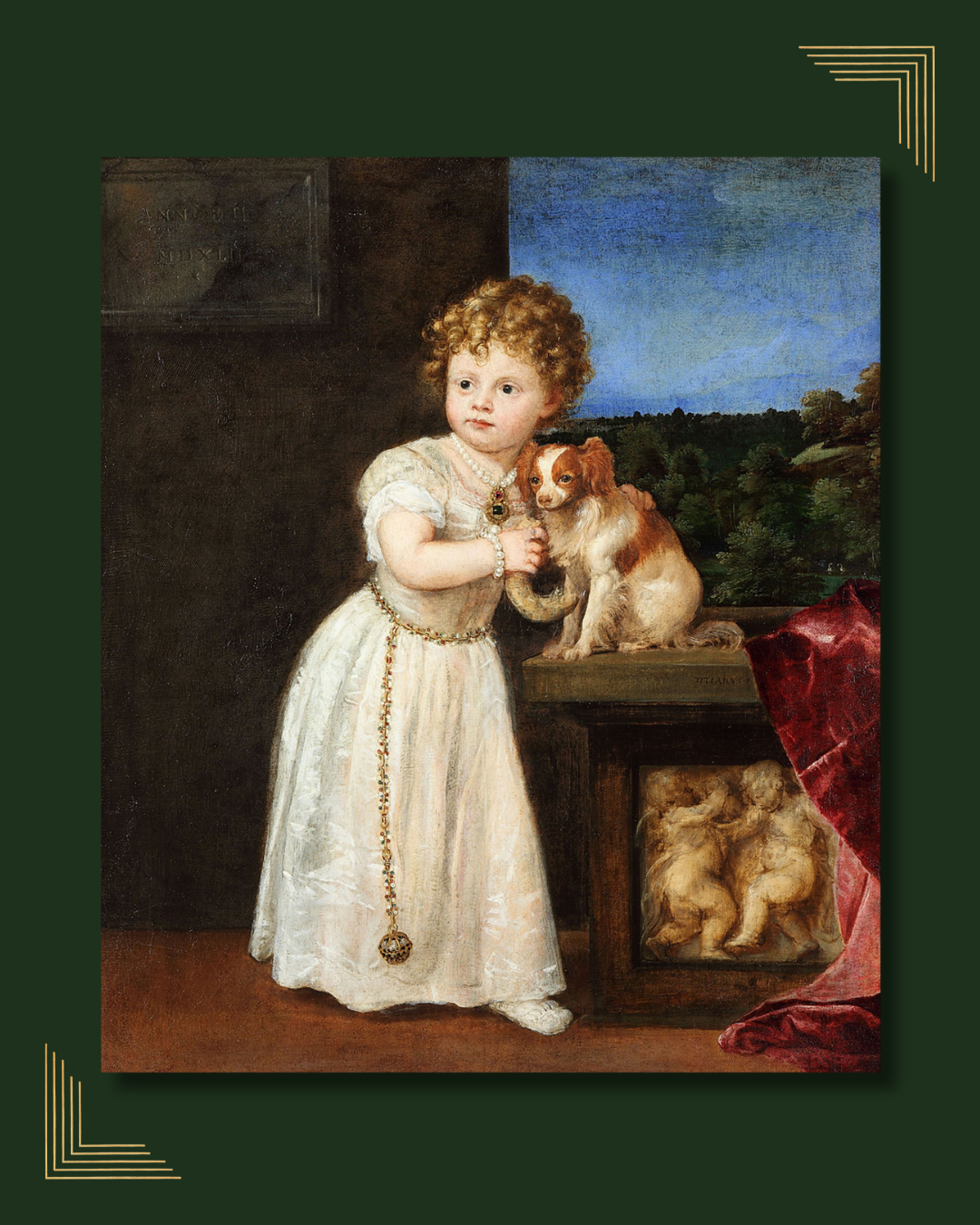
This celebrated portrait by Titian, dated to 1542, depicts 2 year old Clarice Strozzi – the daughter of Roberto Strozzi and Maddalena dei Medici – who were living in exile in Venice from 1540 to 1542.
It’s said that this portrait is considered an example of ‘one of the most beautiful child portraits in the world’ – and Titian was praised for capturing the beauty of youth, playfulness and innocence.
BUT is this really so? Beneath the surface there are many hidden symbolisms within this portrait – and along with my interpretations of the jewellery – gives ‘another’ dimension to its meaning.
First, Clarice is depicted in a simple white dress – the colour of which is said to be a nod to childhood innocence and purity. AND yes this is so. She’s also wearing a pearl necklace of chunky white pearls – and ‘the pearl choker’ was typically given to babies to signify purity, innocence and the waters of baptism.
However, white is associated with brides – and whilst this is not necessarily saying that Clarice is a ‘bride to be’ – there are other hidden references that suggest this painting ‘also’ portrayed her future fertility, her future dowry and her future prospects ‘as a bride’.
The surrounding imagery reinforces these layered meanings. To the right of Clarice we can see the carvings of 2 playful ‘Putti’ – chubby, winged male infants who are either ‘playing’ mischievously or fighting. Religiously, Putti represented divine love, purity and innocence. And in secular art, they represented romance, playfulness and the joys of human life – which later led on to them being used to promote fertility.
Then we have Clarice’s dog – a seemingly innocent inclusion? Dogs on one hand, represented loyalty and faithfulness as well as wealth and high social standing. But on the other hand – dogs were featured in portraits of couples to represent marriage faithfulness and the desire to have a child. Hence ‘also’ a nod to Clarice’s future prospects as a faithful companion whilst referencing her future fertility.
The ‘biscuit’ that Clarice holds is an Italian ‘sweet treat’ called a ‘ciambella’ – and why wouldn’t a child innocently share her cake with her dog? But the ciambella with its continuous round form – represented unity, continuity and the cyclical nature of life (birth and death) and was an important inclusion in ‘family’ celebrations.
And then if we look super closely at the top right side of the painting – within the outside scene featuring a rich blue sky contrasted by a dark green landscape – you’ll find 2 tiny swans swimming in the lake. Swans were symbols of grace, beauty and love, transformation and wisdom – but they were also associated with purity and innocence as well as representing fidelity – as swans are known to pair for life.
Now if we study the jewellery itself – we find further symbolic meaning. Clarice wears a pearl necklace with a matching bracelet – constructed from chunky pearls which appear rather oversized for a 2 year old. On one hand, pearls symbolised status and wealth – as they were fashionable yet expensive items to have owned at this time. On the other hand when specifically given to young females – pearls represented purity, innocence and the ‘waters of baptism’ as a celebration of new life and new possibilities.
From her pearl necklace hangs a gem-set gold pendant – another piece seemingly too large for her small frame. Set with a red gem and a dark stone and finished with a pearl drop, the pendant strongly recalls Medici jewellery traditions. Clarice’s mother belonged to the Medici family, who were known to use distinctive jewels to assert lineage, allegiance and political authority.
Diamonds and rubies were a favoured Medici combination and frequently appeared in portraits of Medici women to mark family membership and elite status. (Whilst the darker gem appears black in colour we know that artists painted diamonds in silver pigments which later tarnished to darker colours over time.) So this raises the possibility that the pendant was a familial jewel, ‘passed down’ from Clarice’s mother – and intentionally chosen to assert her ‘membership’ to the Medici family and suitability for a future betrothal, despite the family’s exile.
A further detail appears on Clarice’s right forefinger, where she wears a gold ring with a pale blue stone in it. Its colour does not ‘match’ the gems in either her pendant or girdle, but instead mirrors the blue of the sky in the distant landscape, subtly drawing the viewer’s eye outward. The colour blue was a costly pigment to have used (made by grinding the gemstone lapis lazuli) and Titian was known to have used blue lavishly in his paintings – hereby signalling wealth. As well as that, the blue sky carried Marian symbolism – being associated with the Virgin Mary during this time who was predominantly painted in blue – and hence links the portrait to purity, innocence and spiritual virtue.
Around Clarice’s waist is an elaborately jewelled gold girdle suspended from which is an ornate gold pomander on a similar long jewelled chain. If we look closely we can see that this girdle consists of white, red and possibly dark blue or green colours – either enamels or again gem combinations like diamonds, rubies and sapphires.
Pomanders were fashionable accessories for females at this time – worn to showcase wealth and status – but they also served the function of driving ‘smells’ and illness away with their infusions of scents. Here the ‘girdle’ itself symbolised Clarice’s ‘chastity’ whilst the pomander acted as protective amulet safeguarding the child against ailments, as well as guarding her moral virtue.
The portrayal of the oversized nature of Clarice’s pearls along with her large gem-set pendant – yes of course showed the girl’s status in society…particularly at this time when her family were in exile. This would’ve been a nod to her family’s continued wealth. BUT it also showcased that these ‘jewels’ highlighted the wealth of this girl’s dowry.
Together Clarice’s jewellery and the other hidden symbols in this painting, communicate far more than childhood adornment. First they assert wealth, lineage and her status in society. BUT given the oversized nature of Clarice’s jewels along with the many references to her suitability and future prospects as a bride – her jewellery may also highlight the value of her dowry. In this way, Clarice’s portrait operates as a powerful political and financial statement – as despite exile, this was a family to be taken seriously – and one that was secure in status and wealth, rich in connections and firmly invested in its future lineage.
References:
Fig 203: 1542
Portrait Of ‘Clarice Strozzi’ depicting the 2 year daughter of Roberto Strozzi and Maddalena dei Medici wearing: a gem-set gold pendant suspended from a chunky pearl necklace, a matching pearl bracelet, a delicate gem-set ring, and an elaborately jewelled gold pomander hung from a decorative waist girdle.
By Titian, Venetian
Staatliche Museen, Berlin
Image available via:
Wikimedia Commons:
https://commons.wikimedia.org/wiki/File:Clarissa_Strozzi,_por_Tiziano.jpg
Selected literature:
McAleer: Children’s Jewellery In Europe: Traditions And Contemporaneity: PhD Diss Royal College of Art, 2003: pp369-370 fig 203
Brown; Vlieghe: Van Dyck: 1599-1641: 1999: p168 fig 1