Upon Queen Elizabeth I’s death, England was ruled by a new sovereign, James I (reigned 1603 – 1625) and with him, the lavish fashions so central to the Court circle of the previous Queen, continued into the reign of the new monarchy. King James was, however, documented to have sold much of the vast amounts of jewellery amassed by his predecessor Elizabeth I, but equally, the new royals were known to have acquired sumptuous jewels of their own.
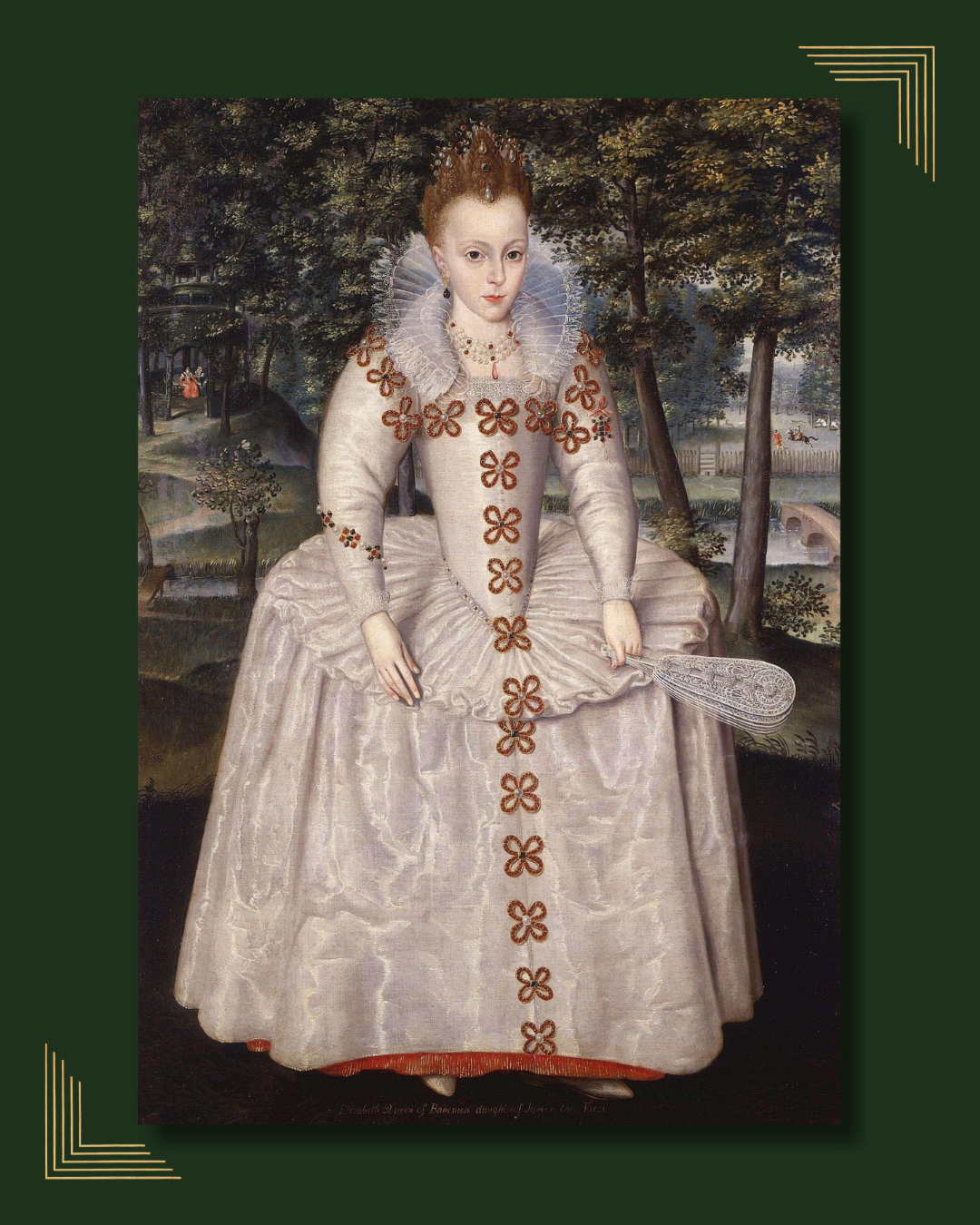
This early 17th century English portrait painted in 1603 by Robert Peake depicts Elizabeth (born 1596 – 1662), the daughter of King James and his wife, Anne of Denmark. The seven year old Princess is elaborately adorned: in her hair she wears pearl, ruby and diamond ‘bodkins’ (hair pins); in her right ear, a black diamond drop earring; around her neck, a triple-stranded pearl and ruby necklace, with a ruby drop.
Elizabeth’s white ‘farthingale’ dress is also encrusted with jewels: running along the shoulders, top of the bodice and down the front of the gown are twenty bow- or flower-shaped ruby ornaments with either pearls or diamonds set at each of their centres; near the cuffs on her right sleeve, a selection of ruby, diamond and pearl ornaments in various motifs; at the top of her left sleeve hanging from a fashionable baroque-style fabric bow, a ruby, diamond and pearl brooch with pendant pearl-drop.
Although entirely in keeping with the styles evident in children’s portraits at the close of the 16th and beginning of the 17th centuries, the sheer extravagance of Princess Elizabeth’s jewellery reflects King James’s notion that a monarch’s dress should be a sign of their status. Like the painting itself, Elizabeth’s jewels were a symbol of her family’s position as the new figureheads of England, and Elizabeth, described as ‘the most eligible Protestant Princess in Europe’, was a statement of their imminent prosperity.
The luxuries bestowed upon Elizabeth continued throughout her father’s reign and when she later married in 1613, the jewels of the bridal procession were said to be so ‘dazzling’ that they were compared to the ‘stars of the milky way’.
References:
Fig 216: 1603
Portrait of ‘Princess Elizabeth (Elizabeth of Bohemia, ‘The Winter Queen’), 1596 -1662, aged seven’ depicting Elizabeth, the daughter of King James I of England wearing: bodkins of gems and pearls in her hair; black diamond drop earrings; a triple-stranded pearl and ruby choker; 20 gem-set bow- or flower-shaped ruby jewels adorn her gown; gem-set jewels adorn her right sleeve; a gem-set brooch suspended from a bow adorns her left sleeve.
By Robert Peake, English
National Maritime Museum, London
Image available via:
The Royal Museums Greenwich (England), Accession no. BHC4237
https://www.rmg.co.uk/collections/objects/rmgc-object-15650
Wikimedia Commons:
https://commons.wikimedia.org/wiki/File:Eliz_bohemia_2.jpg
Selected literature:
McAleer: Children’s Jewellery In Europe: Traditions And Contemporaneity: PhD Diss Royal College of Art, 2003: pp386-388 fig 216
Scarisbrick: Tudor and Jacobean Jewellery: 1995: p22 fig 12