Portraits of babies and young infants, both male and female, dating from around the 16th – 17th centuries, emphasise that, for the more affluent child at least, coral’s properties as a teething aid progressed to be incorporated within specific teething implements.
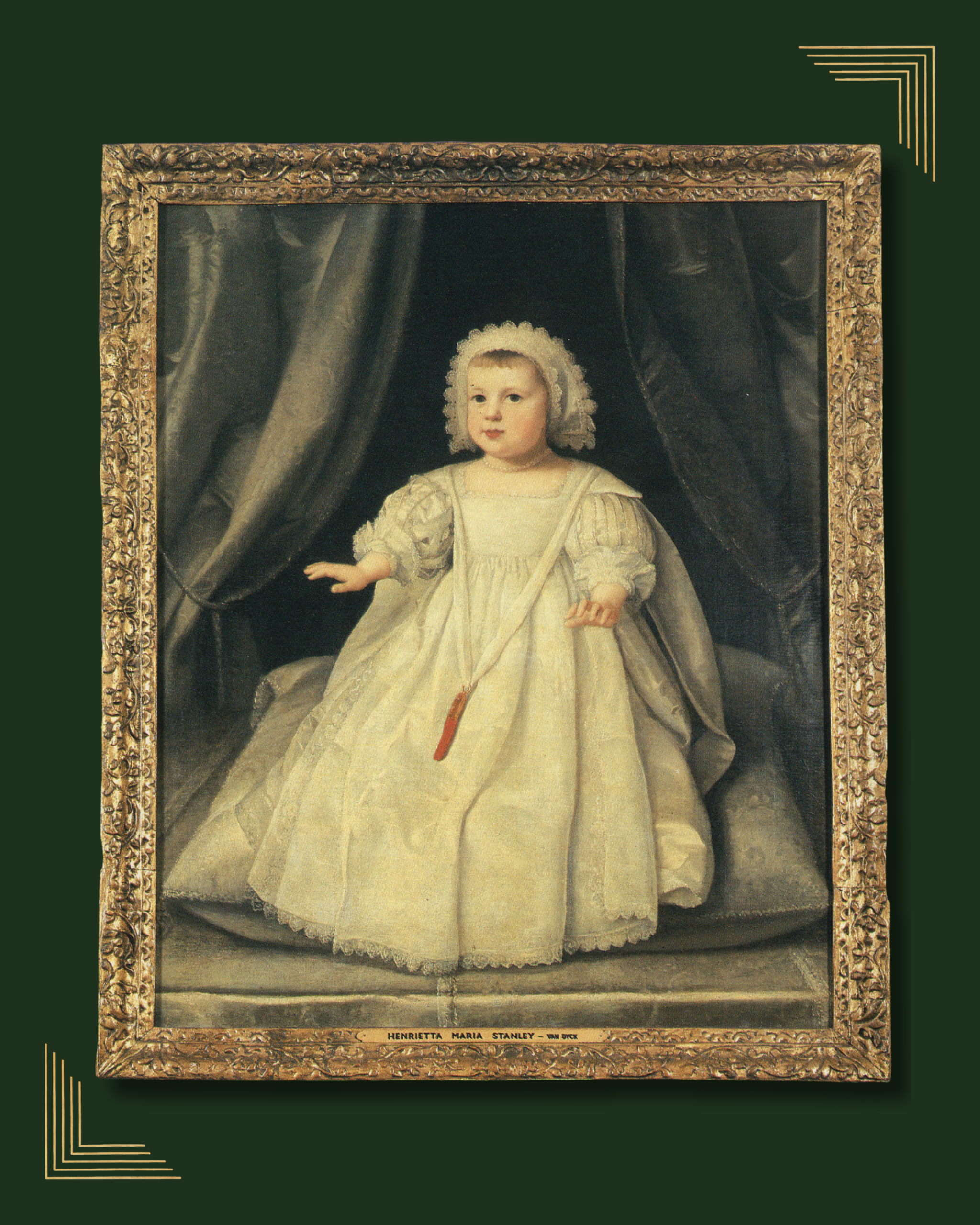
This painting from 1630 – 1631, for example, depicts the one year old Lady Henrietta Stanley dressed all in white with a choker of pearl beads (pearls were a fashionable jewellery type worn by the females of the period, but in relation to children, the pearl represented baptism, purity, innocence and virginity).
Henrietta is also portrayed wearing a long white neck ribbon, suspended from which hangs a stick of coral, set in gold. This ‘stick’ of coral was known as a ‘coral stick’, ‘gum stick’ or ‘teether’, and characteristically consisted of singular stems, branches, or twigs of coral set in elaborate silver, silver-gilt or gold mounts.
These implements were not only worn around the neck and in a painting which mirrors the previous portrait, ‘Babe with Coral’ (1638, Fig 129), the young subject, dressed identically in white to Henrietta Stanley, clutches a coral teether suspended from the waist. The identity of this child is uncertain but it is possibly a child of the 1st Duke of Hamilton, either the eldest girl, Henrietta Maria, who died as a young infant or his youngest son, Lord William. The portrait illustrates how this coral stem, identical to the previous being similarly set in gold and suspended from a white ribbon, could be held in the hand by the teething infant.
In both of these paintings the artists, through the unblemished ‘whiteness’ of their costume (and Henrietta’s pearls), have portrayed how young infants were virtuous yet defenceless against evil influences. This is accentuated and contrasted against the vibrant red of the talismanic coral sticks, which the viewer is instantly drawn towards, highlighting how society placed great importance upon such protective artefacts.
Like religious paintings depicting the Christ child with his coral amulets, these children too needed to be safeguarded, and even the 17th century English midwife Mrs Jane Sharpe, recommend that a stick of coral should be attached to babies after baptism, as protection against various ‘evil’s’.
References:
This object is referenced here as part of a broader visual and textual study of children’s jewellery in historical art.
Fig 128: c.1630 – 1631
Portrait ‘Lady Henrietta Stanley’ depicting a baby girl wearing a pearl choker, and a coral teething stem, set in gold, hung on a white ribbon around her neck
Anglo-French
Private Collection
Published in:
McAleer: Children’s Jewellery In Europe: Traditions And Contemporaneity: PhD Diss Royal College of Art, 2003: pp281-283 fig 128
Kevill-Davies: Yesterday’s Children: The Antiques and History of Childcare: 1991 / 1998: p56 colour plate 3